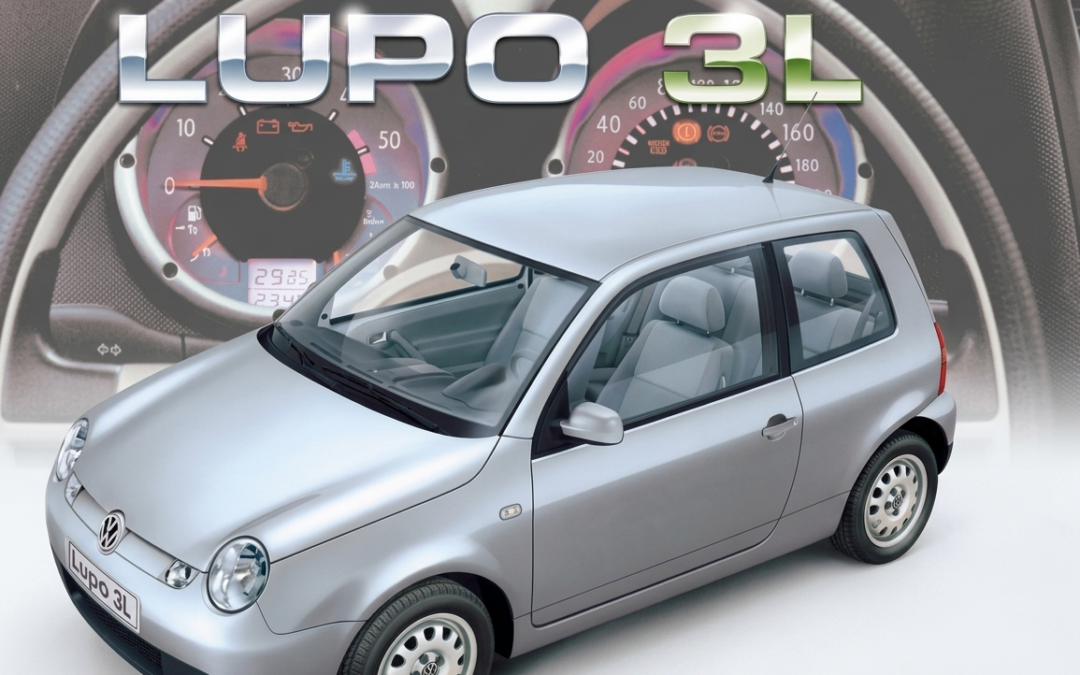
The VW Lupo 3L is one of the finest examples of fuel efficiency first. Built from 1999 to 2005, it was the world’s first production car to officially achieve 3 litres per 100 kilometres — that’s 94.2mpg UK — without a battery, without a motor, and without a five-figure premium over a normal car. Today, you can pick one up for a few thousand pounds (if you can find one!). A base-model electric city car will set you back at around £20,000.
But the Lupo 3L isn’t just a cheap way to save money at the pump. It’s a masterclass in the engineering principles that put fuel economy at the forefront of its design and development. It’s a hypermiler wet dream.
Official Specs at a Glance
- Engine: 1.2-litre three-cylinder TDI diesel (code: ANY)
- Power: 61hp (45kW) @ 4,000rpm
- Torque: 140Nm @ 2,400rpm (later revised figures cite up to 300Nm — the lower figure reflects early official data)
- Transmission: 5-speed automated manual (ASG) with Tiptronic mode
- Drivetrain: Front-wheel drive
- Kerb weight: 803–854kg (depending on spec and year)
- 0–62mph: 14.5–14.7 seconds
- Top speed: 103mph (165km/h)
- Official fuel consumption: 3.6L/100km urban / 2.7L/100km extra-urban / 3.0L/100km combined
- CO₂ emissions: 81g/km
- Drag coefficient (Cd): 0.29
- Production years: 1999–2005
- Body style: 3-door hatchback
- Official economy in mpg: approx. 78mpg urban / 104mpg extra-urban / 94mpg combined
But why 3L and why the interest now?
The “3L” in the name isn’t engine displacement. It refers directly to the car’s official fuel consumption figure: 3 litres per 100 kilometres (94.2mpg UK), which was an outstanding result by any standards when it was achieved. That figure is the starting point, not the ceiling. The car’s official combined figure is already exceptional, but as you’ll see, real-world drivers have beaten it significantly.
We won’t bore you with the current fuel price “issues” — what we will point out is the welcome pivot by many motoring channels away from their usual “MOAR POWERRRR”, focusing on what is really hitting motorists in 2026: their wallet. In the most recent video from TDC (Top Dead Centre), the boys go on a quest for the most efficient £3,000 car and stumble across this Lupo 3L over on the continent. It’s a great watch and we look forward to seeing what they manage to squeeze out of it with some hypermiling.
Fuel efficiency before power
The 3L uses a single, highly optimised 1.2-litre three-cylinder TDI diesel, producing 61hp with 300Nm of torque available from just 1,400rpm.
The engine runs with a turbocharger using variable blade geometry, a charge-air intercooler, and friction-reducing designs throughout that pushed thermal efficiency above 40% — a record for a production car at the time. To put that in context, most petrol engines of the era were operating at around 25–30% thermal efficiency.
A gearbox before its time
This is the bit that will genuinely make hypermilers’ eyes light up. One of the most effective techniques in the toolkit is coasting — disengaging drive and letting the car’s momentum carry it toward a junction, a roundabout, or a slower section of road. In most cars, you have to do this manually, and it requires a degree of anticipation and discipline.
The Lupo 3L does it automatically. The car features an ECO mode that limits power to around 41bhp, programmes the gearbox to change up at the most economical points, and — crucially — disengages the clutch completely whenever the accelerator is released, so the car freewheels with zero engine load until you touch either the accelerator or brake again.
On top of that, ECO mode activates a start-stop function — the engine shuts off automatically when the car stops and restarts the moment the accelerator is pressed.
All of this technology was years ahead of mainstream adoption. Most family cars didn’t get this as standard until well into the 2010s.
Weight (or lack of)
Ask any serious hypermiler what kills fuel economy and they’ll give you three answers: weight, weight, and more weight. Every kilogram you’re hauling around costs energy to accelerate, and you never get it back. VW understood this.
The 3L uses aluminium and magnesium alloys throughout — doors, bonnet, rear hatch, seat frames, engine block, wheels, and suspension components. The tailgate uses a sophisticated aluminium-magnesium compound, and even the glass is thinner than standard. Inside, the sound-deadening was stripped back to just the firewall, seats got magnesium frames with slim padding, and standard trim came without air conditioning or a stereo. Even the steering wheel used magnesium.
The result is a kerb weight of just 803kg. Compared to a modern Volkswagen Polo, which weighs around 1,200kg, it’s a featherweight. That 400kg difference is the equivalent of carrying five extra passengers everywhere you go.
From a bangernomics standpoint, that lightweight construction also translates into less wear on tyres, brakes, and suspension components. Less mass means less work for everything mechanical.
Aerodynamics… It’s slick!
The second thing that destroys fuel economy at speed — after weight — is drag. This is where many older economy cars fall down; they’re light, but they’re also boxy. The Lupo 3L isn’t.
VW redesigned the body specifically to reduce aerodynamic resistance, achieving a drag coefficient of 0.29 compared to 0.32 for the standard Lupo SDI — extremely low for a car of its size. Panel gaps were tightened, the body shape was carefully rounded, and various subtle tweaks were applied that you’d never spot in a car park but which make a meaningful difference once you’re moving at any speed above about 50mph.
For hypermilers who spend time on dual carriageways and A-roads, this is significant. The difference between a Cd of 0.29 and 0.35 — a typical figure for a small hatchback of the era — might not sound dramatic, but at 60mph it compounds across every mile you drive. Combined with the lightweight body and the coasting gearbox, it means the Lupo 3L carries its momentum exceptionally well — which is exactly what you want when you’re trying to stretch every drop.
The Record Books
In 2001, Japanese economy driver Dr Miyano used a standard Lupo 3L to set a world record for the most fuel-efficient circumnavigation of Britain in a production diesel car, averaging an astonishing 119.48mpg. Then in November 2003, Gerhard Plattner drove 2,910 miles through twenty European countries — from Oslo to The Hague — spending just under €91 on fuel, averaging 2.78 litres per 100km or over 101mpg.
In a standard car, that’s bloody impressive!
What the Lupo 3L Teaches Every Hypermiler
Fuel economy, it’s not solved by one big breakthrough — it’s the result of attacking every variable simultaneously. Weight. Drag. Engine friction. Gearbox strategy. Coasting behaviour. Start-stop.
The 3L solved this puzzle by taking techniques and turning them into technology that was way before its time. Twenty-five years after it was built, the 3L is still an engineering marvel, one that put fuel efficiency first and the results show.
If you’re in the UK and have a 3L you’d like to let us “borrow” for some efficiency tests. We’d love to hear from you.
Want to learn more about the VW Lupo 3L?
We’ve just scratched the surface on the 3L and we know you’re looking for more on this amazing little car. Check out the Self Study Programme from VW people and fill your boots!