
Electric vehicles have had a rough ride in the press lately. Range anxiety, charging infrastructure, depreciation horror stories — the headlines haven’t always been kind. But here’s the thing: most of that bad press actually works in your favour if you’re buying used. Someone else took the new-car depreciation hit. Someone else lived through the early software bugs. And now, in 2026, a genuinely excellent used EV could be sitting on a forecourt somewhere waiting for a smart buyer to snap it up.
The question is: when is the right time to buy, and how do you make sure you’re getting a good one?
Why Now Is the Sweet Spot
Cast your mind back to 2021 and 2022. EV sales were booming, government grants were still in play, and thousands of buyers signed three and four-year PCP deals on Kia EV6s, Hyundai IONIQ 5s, Volkswagen ID.3s and Cupra Borns. Those deals are now maturing. The cars are coming back into the market, and they’re coming back with significant depreciation already baked in — sometimes 40 to 50 percent of the original list price.
That’s the buyer’s gain. You’re getting a car that’s genuinely better than its first-generation predecessors, at a price that makes financial sense — and crucially, one that still has meaningful warranty coverage remaining.
The Warranty Brands Worth Targeting
This is where buying smart really pays off. Most mainstream manufacturers offer a three-year vehicle warranty on new cars, which means that many cars have zero manufacturer coverage left. But a handful of brands are different — and those are the ones to target.
Kia is the standout. Every Kia comes with a seven-year, 100,000-mile warranty that is fully transferable to subsequent owners. Buy a three or four-year-old Kia EV6 or e-Niro that’s fresh from a PCP return and you could have three or more years of full manufacturer warranty remaining — on top of an eight-year battery warranty. That’s more than some new EVs!
Just check out some of these prices below, the AWD version would have been more than 50K new. Now they are less than half of that and with extremely low mileage and a warranty until 2030!
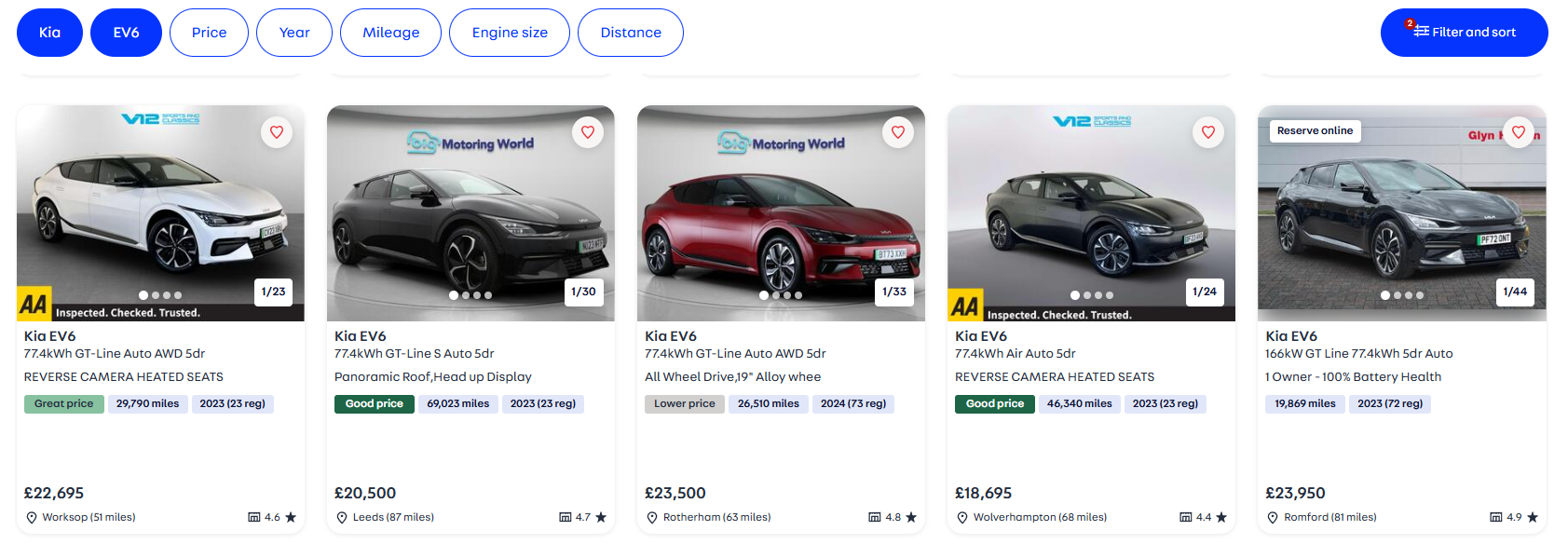
Some examples from Autotrader from 20/4/26
MG matches Kia with a seven-year warranty, also transferable, though the mileage cap is 80,000 miles rather than 100,000. If the previous owner was a high-mileager, check where the car sits against that limit before you commit.
Hyundai offers five years with unlimited mileage, fully transferable. A three or four-year-old IONIQ 5 or Kona Electric could still have a year or two of full vehicle warranty left, which is a genuine bonus.
Cupra offers five years and 90,000 miles on the Born — worth knowing if you’re considering one of the more affordable used EV options.
Toyota and Lexus have a potentially brilliant up-to-ten-year warranty through their ‘Relax’ scheme, but it’s service-dependent — every year of extended coverage requires a full dealer service history. On a used car that’s changed hands once or twice, that history may not be complete. Check carefully before assuming you’re covered.
For the battery specifically, most mainstream EVs carry an eight-year or 100,000-mile battery warranty as standard, and the vast majority of these are transferable. That’s your protection against the biggest unknown in used EV ownership.
Service History
There’s another advantage worth highlighting here. Because these cars were bought new and most owners would have been keen to protect their manufacturer’s warranty — particularly on a car with a seven or eight-year battery warranty at stake — the chances are high that the service history is main dealer stamped throughout. That’s not something you can say about a five-year-old petrol car from a private seller. A main dealer service history means the work was done to manufacturer spec, with genuine parts, by trained technicians. It adds confidence, it supports any remaining warranty, and frankly it just tells you that the previous owner cared about the car. For a used EV buyer, that’s a genuine bonus that often gets overlooked.
The Bad Press Is Your Friend
Let’s address the elephant in the room. Yes, EVs have had mixed press and rightly so for many models – we’ve covered a lot of this with the Volvo EX30 battery issues. Yes, there are genuine questions about public charging reliability, and yes, some early models had teething problems. But that uncertainty has driven used EV prices down to a point where they represent undeniable value for money.
Buying used means someone else absorbed all of that early-adopter risk. The software has been updated. The known issues are documented and hopefully resolved. The real-world range figures are well established. You’re not buying into the unknown anymore; you’re buying a proven quantity at a used-car price.
And if you’re still nervous, the financial exposure on a used EV is considerably lower than on a new one. If something does go wrong and you decide it’s not for you, you haven’t lost £40,000 — you’ve lost considerably less, and you’re not tied into a 4-year PCP deal for a car plagued with issues.
Do Your Homework Before You Buy
A good deal can turn bad quickly if you skip this step. There are three things you need to do before handing over any money.
First, get an HPI check. This is non-negotiable. At around £20, it checks for outstanding finance, mileage discrepancies, write-off history and whether the car has been reported stolen. This matters more on used EVs than almost any other car — a lot of these vehicles came off PCP deals, and not every seller settles the outstanding finance before listing. If there’s finance still attached to the car, it legally belongs to the finance company, not the seller. They can repossess it even after you’ve paid for it. According to figures reported by Auto Express, roughly one in three used vehicles checked had some form of issue that could have cost the buyer dearly. Twenty pounds is a small price to pay.
Second, get a battery health report. An HPI check won’t tell you the state of the battery — that’s a separate job. Many manufacturers make this easy: Kia, Hyundai and Volkswagen all report battery state of health through their apps or dealer tools. For others, a third-party may be able to check using an OBD reader. Anything above 80 percent is generally considered healthy. Below that, factor in what a replacement might cost, or walk away.
Third, check the service history. For any car where the extended warranty is service-dependent — Toyota, Lexus, Suzuki — this is critical. But it matters for all EVs. A patchy service history is a red flag, and it can also void remaining manufacturer warranty coverage.
Buy From a Dealer, Not a Private Seller
This one is simple. Buying from a dealer gives you legal protection that a private sale simply cannot offer. Under the Consumer Rights Act 2015, any fault that appears within six months of a dealer purchase is legally presumed to have existed at the time of sale — meaning the burden of proof is on the dealer, not you. That protection doesn’t exist with a private seller.
Many dealers will also offer their own warranty on top — three months is common practice, though it’s not a legal requirement. Think of it as a bonus rather than a given, and remember your six months of statutory protection is the floor regardless.
Franchised dealers selling approved used cars from their own brand will typically offer something closer to twelve months of dealer-backed warranty. Worth paying a little more for on a higher-value purchase.
You Need a Home Charger
This is the point that often gets missed in used EV guides, and it’s arguably the most important one from a running-cost perspective.
Without a home charger, you’re relying on public infrastructure — and that means paying public charging rates, which can be anything from 40p to 90p per kWh depending on where and how you charge. At those prices, the running cost advantage of an EV over a modern petrol car largely disappears.
With a home charger and an off-peak tariff, the picture is completely different. I had an Ohme Pro charger provided and installed for free with my Volvo EX30, and combined with the Octopus Intelligent tariff, I’m charging at 5.5p per kWh overnight.
If you’re buying a used EV and you don’t have a home charger yet, factor the installation cost into your budget — or look for deals that include it. The charger isn’t an optional extra; it’s the thing that makes the whole equation work.
The Verdict: Smarter Than Buying New
Used EV ownership, done right, is one of the shrewdest financial decisions you can make in 2026. The depreciation has already happened. The warranty — if you pick the right brand — is still running. The running costs, with a home charger and an off-peak tariff, are genuinely transformational. And the bad press that’s been swirling around EVs for the last couple of years has kept prices lower than they probably should be.
Add some hypermiling techniques into the mix and you could be looking at around 2p a mile — a drop in the ocean compared to their petrol-guzzling alternatives.
The golden window is right now. Three to four-year-old cars from Kia, Hyundai, MG and Cupra represent exceptional value — proven technology, meaningful warranty coverage, and a running cost that will make your petrol-buying friends do a double take.
Pick the right car, check its history, get the home charger sorted, and plug in on an off-peak tariff. The rest takes care of itself. Given the chance, with all my research into EVs, battery technology and the fact that new EVs are often plagued with issues, I would think twice before buying something new.
Let’s hear from you
Have you taken advantage of used EV prices? What’s your experience and would you choose another? Can you suggest a used EV that represents great value? Let us know in the comments