
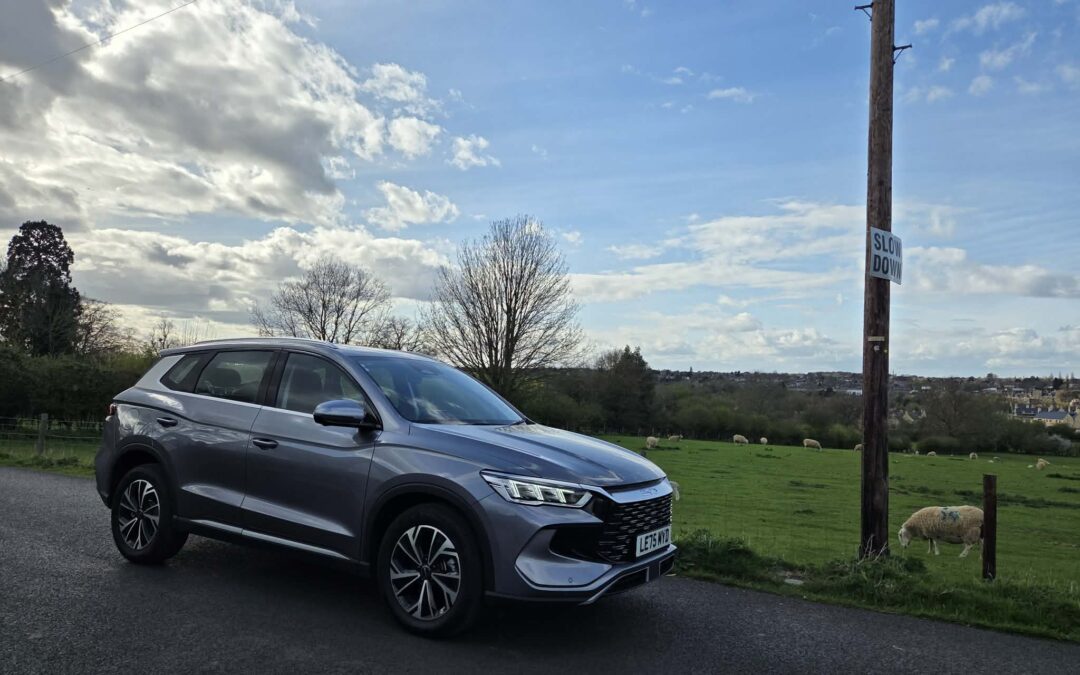
My Volvo EX30 is gathering dust.
That is not something I expected to be writing when I took delivery of it. The EX30 was supposed to be my daily. Smart, compact, capable, and with a proper hypermiler’s range on a charge. But since mid-March 2026 I have been spending almost all of my time in BYD cars, and the honest truth is I have not missed the EX30 once.
It is probably time for a catch-up.
Where It Started
The BYD relationship began in late March with the Sealion 5 DM-i, a plug-in hybrid that uses BYD’s DM-i system to run as an electric car first and a petrol car only when it has to. Over 1,000 miles I was consistently hitting 2p per mile. That figure still makes me smile.
Then came the Atto 3 Evo launch event at the beginning of April, BYD’s Dynamic Launch Event headed by Bono Ge, Country Manager for BYD UK. Then the Atto 2, a fully electric SUV that I took to the London to Brighton EV Rally and returned 5.9 miles per kWh across 60 miles of real London traffic. Under 1p per mile. Less than a packet of crisps for the journey.
Four months. Three cars. Thousands of miles. A customer experience day at BYD UK head office. Here is what I actually think.
The Thing Nobody Talks About: The Interior
When people think about Chinese car brands there is still a persistent assumption about quality. That assumption is wrong, and nowhere is it more wrong than inside a BYD.
The interior fit and finish on every BYD I have spent time in has been genuinely impressive. Panel gaps are tight. Materials feel solid. Switchgear has weight to it. Seats are comfortable in a way that takes miles to appreciate rather than minutes. The Sealion 5 felt like a premium family SUV from the moment I sat in it. The Atto 2 had an interior that felt more considered and deliberate than cars costing considerably more.
I keep coming back to the same phrase: it has no business being this good at this price.
The Atto 3 Evo raised that bar again. The upgraded Alcantara-style finishes and yellow contrast stitching give it a sense of occasion without tipping into gimmick territory. And then there are the guitar-string door pocket retainers, a quirky Atto 3 signature that I had never seen before and that somehow works completely. Apparently someone once played Enter Sandman on them, which tells you everything about the kind of personality BYD is willing to inject into a cabin.
The design language is consistent across the range too. Pick up a BYD and you know it is a BYD. That brand coherence has arrived faster than most European brands managed in their first decade of UK market presence.
The Atto 3 Evo: Rear-Wheel Drive and a New Face
The Atto 3 Evo was the car I was most curious about going into the launch event. Updates to existing models can be underwhelming. This one was not.
The switch to rear-wheel drive gives the Atto 3 Evo a naturally confident balance that the front-wheel drive original did not have. At the launch event we recorded 0 to 62mph in 5.2 seconds, which is 0.3 seconds quicker than BYD’s own official claim. The steering is precise and weighty in a way that feels considered rather than artificially tuned.
The Dragon Face front end is the most visible exterior change. It gives the car a distinctive identity that feels recognisably BYD rather than generic EV. It is the kind of styling decision that ages well because it comes from a clear design philosophy rather than a trend.
The stalk-based drive controls are a genuine improvement over the centre console approach on the Sealion 5. Coming from the EX30, which also uses stalks, they felt immediately natural. It is a small thing that makes a meaningful difference to the everyday experience of driving the car.
One honest observation: the efficiency data screen on the Atto 3 Evo needs some work. For a hypermiler, the way consumption information is presented matters enormously, and right now it does not give you the granular real-time data that makes it possible to really optimise your driving. The hardware is clearly capable. The software needs to catch up. I will be pressing for a longer loan to do a proper efficiency test, because an hour at a launch event is a first date, not a relationship.
The Efficiency Numbers Are Real
I run every car I test through proper real-world efficiency testing. Not a controlled route, not ideal conditions, not a Sunday morning with empty roads. Daily driving, motorway runs, stop-start traffic, the lot.
The BYD numbers have held up under all of it.
The Sealion 5 DM-i at 2p per mile in hybrid mode is a figure I would have dismissed as marketing before I drove it. It is not. It is what you get when you drive the car the way the system is designed to be driven. You can read exactly how in our Hybrid Hypermiling Techniques guide.
The Atto 2 at 0.91p per mile is the figure that has attracted the most attention. People do not believe it until they see the method. It is not a trick. It is what the car returns when you apply consistent EV hypermiling discipline on Octopus Intelligent overnight charging. The techniques are in our EV Hypermiling Techniques guide.
For comparison, the Volvo EX30 sitting on my driveway is a good car. But the BYDs have made it feel less special. That says more about how far BYD have come than about any failing on Volvo’s part.
You Are Seeing More of Them on the Roads
When I picked up the first Sealion 5 in March, people would stop and ask what it was. By the time the Atto 2 went back, I was seeing BYDs on the road almost every day. The growth in UK visibility has been noticeable and rapid.
This is not accidental. BYD is investing seriously in UK market presence, dealer network, charging infrastructure partnerships and event sponsorship. The London to Brighton rally had BYD as the headline sponsor with the official pace car. That is not a brand testing the water. That is a brand arriving with intent.
The name is also registering with people who are not car enthusiasts. That shift from “BYD, who?” to “oh yes, I have seen those” matters enormously for a brand trying to establish itself in a sceptical market.
The Customer Experience Day
Earlier this year I attended a BYD customer experience day at their UK head office. These events can be exercises in corporate polish that tell you very little about what a brand actually thinks. This one was different.
What struck me was the genuine interest in owner feedback. Not the managed, marketing-filtered kind. Real questions about real experiences. What works, what does not, what owners wish they had been told before they bought. BYD were listening in a way that felt substantive rather than performative, and the team asking questions were specific and technical rather than deflecting.
For a brand that is still relatively new to the UK market, that appetite for direct owner feedback is encouraging. It suggests a company that understands it is still learning the UK consumer and wants to get things right rather than assuming it already has.
What Is Coming: Flash Charging and the Incoming Model Range
One of the things that has genuinely excited me in conversations with BYD is what is coming rather than what is already here.
Flash charging is the headline. BYD has developed megawatt-level charging technology that can add significant range in just a few minutes, already deployed in China. The implication for long distance EV travel is significant. The current anxiety around fast charging, the queues, the wait times, the uncertainty about whether the charger will work, starts to look very different when you can replenish meaningful range in the time it takes to make a coffee. The UK charging infrastructure will need to catch up, but the technology is coming and BYD is ahead of most of its competitors in deploying it.
The broader incoming model range reflects a brand thinking carefully about which segments matter in the UK. There is genuine innovation in what is planned, not incremental updates to existing models but meaningful steps forward in range, efficiency and technology.
One Honest Criticism
I said this would be honest, so here it is.
Some of the UI translation into English still needs work. The most obvious example is the low battery warning, which tells you to “Charge in Time” rather than something a native English speaker would naturally say. In a car where everything else feels considered and deliberate, it stands out.
To be fair to BYD, they are aware of it and it is being addressed in future software updates. For a brand selling cars into a market where English is the first language, getting the copy right matters. It is the kind of detail that European brands have had decades to refine and BYD is still catching up on. It will not put anyone off buying the car. But a brand this good in every other area deserves to get the small things right too.
The Honest Bottom Line
Four months ago I would have told you BYD was an interesting brand worth watching. Today I would tell you it is a brand worth buying from.
The efficiency numbers are real. The interior quality is genuinely impressive. The design language is consistent and confident across the Sealion 5, Atto 2 and the new Atto 3 Evo. The customer relationships feel authentic. And what is coming in terms of technology, particularly on charging, suggests a company that is not just competing with the established EV players but trying to leapfrog them.
My EX30 is still on the driveway. But increasingly, when I reach for a key in the morning, it is not the one I reach for.
If you own a BYD or are considering one, I would genuinely like to hear from you. Drop a comment below or get in touch. We are building a picture of real-world ownership experience across the range and your input matters.
Related reading: