
It’s taken more than three months, but UK EX30 owners are finally receiving an official letter from Volvo about the battery fire‑risk recall. Owners have been living with a 70% charge cap since before Christmas.
Now, with the DVSA formally involved, Volvo has begun sending out a safety notice that confirms what many suspected all along: this isn’t a software issue or a “precautionary measure”. It’s a hardware defect inside the high‑voltage battery modules, and in the wrong circumstances, it can overheat and potentially catch fire.
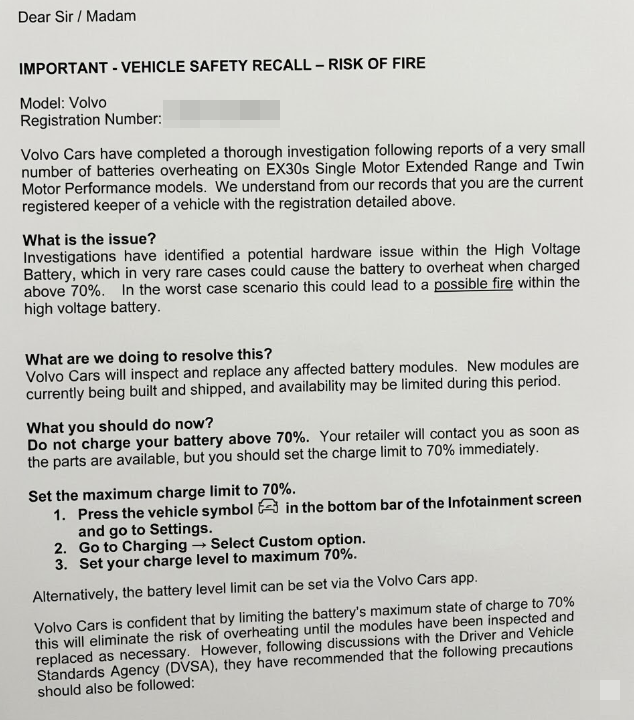
Dear Sir / Madam
IMPORTANT – VEHICLE SAFETY RECALL – RISK OF FIRE
Model: Volvo Registration Number: [Redacted]
Volvo Cars have completed a thorough investigation following reports of a very small number of batteries overheating on EX30s Single Motor Extended Range and Twin Motor Performance models. We understand from our records that you are the current registered keeper of a vehicle with the registration detailed above.
What is the issue?
Investigations have identified a potential hardware issue within the High Voltage Battery, which in very rare cases could cause the battery to overheat when charged above 70%. In the worst case scenario this could lead to a possible fire within the high voltage battery.
What are we doing to resolve this?
Volvo Cars will inspect and replace any affected battery modules. New modules are currently being built and shipped, and availability may be limited during this period.
What you should do now?
Do not charge your battery above 70%. Your retailer will contact you as soon as the parts are available, but you should set the charge limit to 70% immediately.
Set the maximum charge limit to 70%.
Press the vehicle symbol [Car Icon] in the bottom bar of the Infotainment screen and go to Settings.
Go to Charging → Select Custom option.
Set your charge level to maximum 70%.
Alternatively, the battery level limit can be set via the Volvo Cars app.
Volvo Cars is confident that by limiting the battery’s maximum state of charge to 70% this will eliminate the risk of overheating until the modules have been inspected and replaced as necessary. However, following discussions with the Driver and Vehicle Standards Agency (DVSA), they have recommended that the following precautions should also be followed:
A recall that arrives months late
The most striking thing about the letter isn’t the content — it’s the delay. UK owners have been left in the dark while other markets received clearer communication weeks earlier. Some found out more from forums and leaked dealer memos than from Volvo itself.
For a brand that built its reputation on safety, the silence has been baffling.
Still no timeline for repairs
Depite the recent flurry of letter to owners, Volvo still refuses to give any kind of timescale.
Owners are told that new battery modules are “being built and shipped”, which sounds reassuring until you realise it’s the same line they’ve been using since December. Retailers have no dates. No parts. No schedule. Just a list of customers they can’t help.
Three months in, that’s simply not good enough.
Living with a 70% cap is not sustainable
Volvo’s letter repeats the instruction to limit charging to 70%, as if this is a minor inconvenience. For many UK drivers, it’s anything but.
A car sold with a 250–300 mile range is suddenly operating at something closer to 150–180. That’s a huge drop, especially in winter, on motorways, or for anyone without home charging.
And that’s where the real‑world impact bites. Plenty of owners are now forced into public charging far more often than before — and paying the eye‑watering rates that come with it. Rapid charging at 70% is less efficient too, so you’re paying more for less. What’s even more worring is the impact rapid DC charging has on EV batteries. The situation is dire.
It’s certainly not what you expect from a brand‑new EV.
Communication has been poor from day one
The letter itself is polite, measured, and carefully worded — but it doesn’t address the elephant in the room: Volvo’s communication has been consistently poor.
- No regular updates
- No transparency about parts availability
- No explanation for the three‑month delay
- No support for owners who rely on their car for work
- No compensation for increased charging costs
- No courtesy cars for those whose range is now unusably low
Owners have been left to fend for themselves, trying to make sense of a recall that seems to move at a glacial pace. Many owners have resorted to social media – such as the Volvo EX30 UK Facebook page
A vehicle that isn’t fit for purpose
Under UK consumer law, a vehicle that cannot be used as advertised — or safely charged to its full capacity — is not fit for purpose. Right now, the EX30 falls squarely into that category.
Owners bought a car with a specific range, performance and capability. They’ve ended up with something far more limited, and for an indefinite period. Some are now questioning whether they should be pushing for refunds or replacements.
Volvo needs to do better
Now that the official letters are finally going out, Volvo can’t hide behind silence anymore. UK owners deserve:
- A clear timeline for repairs
- Transparency about parts production and supply
- Compensation for increased charging costs
- Mobility support where needed
- Honest, proactive communication
UK owners are being asked to live with a compromised car, a fire‑risk warning, and a manufacturer that seems reluctant to take responsibility. Three months of waiting is already too long. The fact that the official notification is only arriving now makes it even harder to swallow.
Let’s hear from you
How has the EX30 battery issue impacted you? Are you out of pocket? Have you managed to reject your car? Let us know your experiences in the comments.
Read more
Want to read more about the EX30 battery issues – check out our articles here – https://www.hypermiler.co.uk/category/volvo-ex30


My elderly parents live 265 miles away – with this in mind I bought a ‘extend range’ so that it would be an easy one stop (comfort/food break) journey. This is now not possible. I have always charged to 100% overnight on my home charger, enough times to clock up 14,158 miles. We have been away to Suffolk twice, and Norfolk once with two or three fast charges to 100% each time we have been away on holiday and then there is three visits to Cornwall which again will of had a fast charge to 100% each way and probably 1 of my dads solar/battery set up to 100% whilst we have been there. When my father had a fall in January and was hospitalised I went to help my mum and ignored the advice, charging to 100% the night before, on the way down, once whilst we were there and once on the return journey when he was back on his feet in February – other than that I have been generally only charging to 70% at home. My biggest observation that I would like an answer to is does the ambient temperature and lack of cooling airflow exacerbate the risk of fire – the only actual documented occurrence was on a 30 -35 fegrees centigrade day, in an enclosed workshop – was this a contributing factor, how much does it increase the risk of fire ? – is outdoors in the UK at under 20 degrees less risky ?
Andy
I am absolutely disgusted, have complained via the ombudsman, I have done nothing but complain about our EX30 for the last 18 months, technical issue after issue, constantly being locked out of car miles from home without being able to access the car, complete blackout from the main console whilst driving, constant charging errors really not fit for purpose and not what we paid for! We have ours on PCP and we are now asking for reimbursement , this has been a nightmare since we bought it in May 2024. Feel like a guinea pig to test drive the EX30, hopefully this leaves Volvo with egg on their face, I have a response from the ombudsman saying they will have a decision back to me about our complaint within 90 days. Volvo have made no effort to apologise or offer compensation for all of the additional charging and we cant plan long trips as the car is useless at a max of 70% capacity.
Hi, i have just received a letter for the first time stating that as per previous communications (which i have never received) that my car is impacted and that they have noted i have been continuing to charge above 70% and must stop. I’m flabbergasted as when i originally heard about this on forums i checked my vin on the Volvo website and my car wasn’t impacted. I haven’t received any letters or emails before this one. This means i have effectively been charging and using the car unsafely for 3 months? I am disgusted tbh. I am in the process of writing to my finance provider to get a replacement car or my money back.
Volvo have been pathetic on this. I received an email just after Christmas and since then everything has been only as a response from my pushing. I registered a formal complaint the first business day after receiving the email as real world 140miles is not fit for purpose. I didnt reject the car I merely requested they supply a vehicle that could supply 200miles on a charge and they rejected this and stated that was that.
I’ve had nothing since except responses to my snidey social media comments so clearly they only bother about the marketing impact of this on public forums. The UK chief is a marketer not an engineer.
As it stands nearly 3 months later no formal fix and no formal updates. As it stands I couldn’t possibly recommend anyone buy a volvo and it will certainly be my last as things stand.
Every company suffers the odd product issue but it is how they react that sorts out the good from the bad. Volvo are frankly being crap.
Well said Mark I completely agree with you. I’ve always admired Volvo cars and this is my first. Unfortunately the way they have mishandled this it will definitely be my last!
Only picked up our EX30 the last day of January with not a mention of any of this from the dealership. In fact they set the charge capacity to 80%. Guess we might not have bought the car had we been told. Did some research on the car before buying but guess this situation didn’t come up. Volvo have been a shambles throughout the entire purchase and seems they don’t actually care. With no real idea of any time scale, am now in touch with Citizens Advice and Trading Standards to see what can be done.
Hi Andy – sorry to hear that. If they sold it to you after the 22-01-26 it was officially already recalled and they acted illegally by selling a recalled vehicle.
This article might be of some help
https://www.hypermiler.co.uk/volvo-ex30/volvo-is-illegally-selling-ex30s-to-unsuspecting-buyers
I hope this helps
Cheers Karl
My finance company has rejected my claim for handing the car back so now my only recourse is the Ombudsman. I’m not really sure how to handle that I need time to do more research as I dont want them also rejecting my claim. Volvo UK have been far poorer with communication compared to other countries regarding this battery issue!
So frustrated with Lex Autolease – instead of offering me a new car while we wait for repairs on my Volvo EX30 they provided me with a £200 charging voucher. Bit like a smack in the face as seem to be spending my life charging the car at the moment. Volvo’s positive reputation is disappearing rapidly.
I purchased a Volvo Ex30 Twin Motor for my wife in April 2026. Surely we should have not been sold it when a recall was in place. We bought it from John Clark in Dundee. They did inform us when we picked it up that there was a recall on the battery and this should be replaced by June. Going by comments on here there seems to be no official date for replacing the battery. This would have affected us going ahead with the purchase if we knew there is no definitive time scale for the replacement. When we asked about getting the battery replaced at our local dealer in Stirling they said they had removed all their second hand Ex30’s for sale till the battery replacement had been carried out.
I’ve been slapped with the 70% charging restriction and have just been told by the dealership that I will be lucky if the repair is done by the end of the year. That’s 12 months with a car that’s not fit for purpose. Worse still, I need the car in my capacity as an on call doctor and having to stop and charge the vehicle has led to delays in patient care.
Volvo have the standard ‘we’re sorry’ but no compensation other than a goodwill £200 voucher for charging. It’s just not good enough. My concern now is that when I try and trade this car in the trade in offer will be well below it’s worth due to the battery issue. I feel completely stuck between a rock and a hard place.