
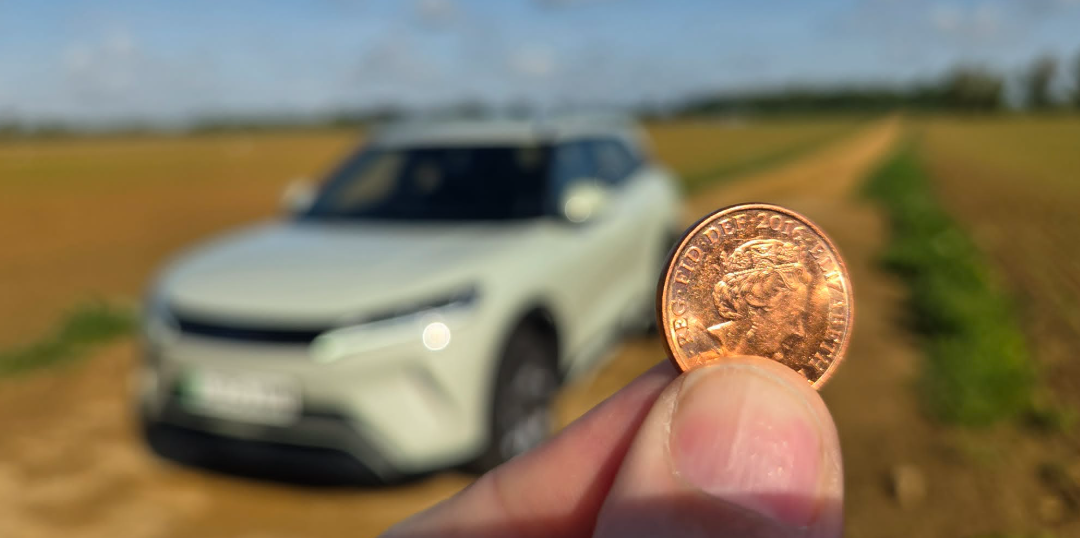
Every night the Atto 2 sits on my drive charging for less than the price of a bag of crisps. That is not a turn of phrase, I have checked. A full overnight charge on Octopus Intelligent costs me less than 90p most nights, and that gives me a car that costs 0.91p per mile to run.
I mention that first because everything else in this article needs that number as context. EV running costs are about to get more complicated, not because charging is getting more expensive, but because the government is adding a new charge that has nothing to do with electricity at all. If you drive an EV or you are thinking about buying one, the next few years matter, so let us go through exactly what you pay now, what changes, and whether hypermiling can do anything about it.
How Much Does It Cost to Charge an Electric Car in the UK?
The honest answer is that it depends entirely on where and when you charge, and the gap between the cheapest and most expensive way to do it is enormous.
At home on a standard variable rate you are looking at around 25p per kWh, based on the current Ofgem price cap. That puts a 60kWh charge from empty at roughly £15. At home on an EV-specific overnight tariff like Octopus Intelligent, which runs at 5.5p to 7p per kWh, the same charge falls to somewhere between £3.30 and £4.20. On the public network it gets worse. Standard and fast public chargers averaged 54p per kWh in July 2026, and rapid or ultra-rapid chargers averaged 80p per kWh, according to Zapmap’s monthly price index. That is the equivalent of roughly 16p and 24p per mile respectively for an average efficiency EV.
So the same car, charged three different ways, can cost you anywhere from under £4 to over £45 for a full charge. That is not a small variation. It is the difference between EV motoring being the cheapest way to drive in Britain and it being genuinely expensive.
How Much Does It Cost to Charge an EV at Home vs Public Chargers?
Home charging on a smart overnight tariff is roughly ten times cheaper per kWh than a rapid charger on the public network. That is not an exaggeration, it is just the maths.
On the Atto 2, I average 16.6kWh per 100 miles. On Octopus Intelligent at the bottom of its 5.5p to 7p range, that works out to 0.91p per mile. Charge the same car on a public rapid charger at 80p per kWh and you are paying closer to 13.3p per mile, nearly fifteen times more for the identical journey.
Public charging still has its place. If you do not have off street parking, or you are on a long trip and need a genuine top up in twenty minutes, rapid charging is what makes EV ownership practical. But if home charging is available to you and you are not using an EV tariff, you are leaving real money on the table every single night. This is why I do everything in my power to avoid public charging, even Hypermiling can’t take the sting out of those prices!
Why Battery Size Matters More Than People Think When They Are Buying
This is the bit that catches people out, and it is worth factoring in before you buy rather than after.
If you have reliable home charging, battery size is mostly about range and convenience. But if you do not, or if you are the kind of driver who ends up relying on the public network more often than you planned, a smaller battery can quietly cost you more overall, not less. A small pack means more frequent charging stops, and every one of those stops on the public network is happening at 54p to 80p per kWh rather than the 5.5p to 7p you would pay at home. A bigger battery lets you do more of your charging on your own driveway, on your own tariff, and only dip into the expensive public network when you genuinely need to.
I made exactly this point in Why You Shouldn’t Cheap Out on Battery Size When Buying an EV, and the charging cost angle is the part people underestimate most. The sticker price difference between the small and large battery version of the same car looks like the whole decision, but it is not. If the smaller pack pushes you onto public rapid chargers every few days instead of letting you charge at home two or three times a week, the running cost gap can eat into that upfront saving faster than most buyers expect. Worth doing the sum properly before you decide, not after.
Don’t have buyers remorse like I did. That bigger battery and increased monthly payment would have paid for itself.
Is It Cheaper to Run an Electric Car Than Petrol in 2026?
Yes, and it is not close, even before you factor in what is coming with eVED.
Petrol currently sits at 153 to 155p per litre. On a typical modern petrol car doing around 45mpg, that works out to somewhere between 17p and 23p per mile once you account for real world driving rather than the official combined figure. Compare that to my Atto 2 at 0.91p per mile on overnight electricity, or the Sealion 5 DM-i averaging 2p per mile in hybrid mode over more than a thousand miles. Even a driver on standard daytime electricity rates rather than an EV tariff is typically looking at somewhere in the 3p to 8p per mile range, still a fraction of petrol.
Over the UK average of 7,100 miles a year, that is the difference between spending roughly £1,200 to £1,600 on petrol and spending somewhere between £65 and £570 on electricity, depending entirely on how and when you charge. If you are weighing this up against finance costs too, our Is EV Finance Cheaper Than Fuel? piece goes through the full sum.
What Is eVED and How Much Will It Cost Me?
This is the one every EV driver needs to understand now, even though it does not start until April 2028.
eVED stands for Electric Vehicle Excise Duty, and it is a new pay per mile charge announced in the 2025 Budget. From April 2028, electric cars will pay 3p per mile driven, and plug-in hybrids will pay 1.5p per mile, on top of the standard VED you already pay. The government has indicated mileage will most likely be verified at MOT test centres rather than through a tracking device fitted to your car, which addresses the obvious privacy concern that came up during the consultation. Drivers will also be legally required to estimate their annual mileage when they renew their car tax.
Here is the part that surprises people when I explain it. eVED is charged per mile driven, not per kWh used. That means how efficiently you drive makes zero difference to what you pay in eVED. Hypermiling cannot reduce this tax. A car doing 3 miles per kWh and a car doing 5 miles per kWh both pay exactly 3p for every mile they cover. It is a road use charge, not an energy charge, and it is worth being clear about that rather than pretending otherwise.
What hypermiling can do is make sure eVED barely dents the overall picture. On the Atto 2 at 0.91p per mile in charging costs, adding eVED’s 3p per mile brings the total to 3.91p per mile from 2028. That is still a fraction of what a petrol car costs to run today, even before petrol prices rise any further. Over 7,100 miles a year, that is roughly £278 total, charging plus eVED combined, against £1,200 or more for the equivalent petrol journey.
You can read more about eVED here – https://www.gov.uk/government/publications/electric-vehicle-excise-duty-eved/electric-vehicle-excise-duty-eved
How Much Is Road Tax on an Electric Car in 2026?
Electric cars are no longer exempt from Vehicle Excise Duty, and the numbers are now very close to what petrol drivers pay.
New EVs registered from April 2025 pay a £10 first year rate, then move to the standard £200 a year rate from year two, exactly the same standard rate every other car pays regardless of fuel type. If your EV has a list price over £50,000, you also pay the expensive car supplement of £440 a year for years two through six, taking your annual VED to £640. That £50,000 threshold is specific to electric cars, up from the £40,000 threshold that still applies to petrol, diesel and hybrid cars, which is a genuine concession that keeps most mainstream EVs out of the supplement entirely.
The point worth making honestly here is that VED itself is not really where EVs save you money any more. From year two onwards it is close to identical between an EV and a petrol car of the same price. The real saving has always been in what you spend keeping the thing moving, not what you spend taxing it.
My BYD Experience and What EV Hypermiling Actually Looks Like
I have spent the last several months living in BYD cars, the Sealion 5 DM-i, the Atto 2, and the Atto 3 Evo, and the efficiency numbers I keep quoting are not marketing figures. They are what I actually got, driving these cars the way I drive everything, which is to say properly.
EV hypermiling is a different skill set to petrol hypermiling, but the underlying principle is the same, you are trying to waste as little energy as possible on every journey. A few things make the biggest difference in practice. Regenerative braking done properly, reading the road ahead and lifting off early rather than coasting to a stop and relying on the brake pedal, recovers a meaningful chunk of energy you would otherwise lose completely. Preconditioning the cabin while the car is still plugged in, rather than running the heater or air conditioning off the battery once you unplug, saves range you would otherwise burn in the first few miles. Tyre pressures matter more on an EV than a petrol car, because the extra weight of the battery pack means underinflated tyres cost you more in rolling resistance. And route planning to avoid stop start traffic where possible does more for your efficiency than any driving technique once you are actually moving.
On the Atto 2, that discipline is what took me from a car that would return decent but unremarkable efficiency to one consistently hitting 16.6kWh per 100 miles, verified across the London to Brighton EV Rally where I recorded 16.9kWh per 100 miles, 5.9 miles per kWh, across sixty miles of real London traffic. That is not a lab test. That is Friday afternoon traffic on the way to Brighton. You can find the full breakdown of the techniques I use in our EV Hypermiling Techniques guide.
Can Hypermiling Offset eVED?
Not directly, and I want to be honest about that rather than oversell it.
eVED is a flat rate per mile. It does not care whether you are driving efficiently or wastefully, so no amount of skill at the wheel reduces the eVED bill itself. What hypermiling does is keep your charging costs so low that even after eVED is added on top, the total cost per mile stays dramatically below petrol. That is the real offset, not against the tax itself, but against the overall running cost picture that the tax is trying to rebalance.
Think of it this way. eVED exists because the government is losing fuel duty revenue as more drivers switch to electric, and it wants EV drivers to start contributing to road maintenance the way petrol and diesel drivers always have through fuel duty. That is a reasonable principle even if the timing and mechanism will be debated all the way to 2028. But the efficiency advantage of driving an EV well, rather than driving it carelessly, was never really about avoiding tax. It was always about avoiding waste. eVED does not change that equation, it just adds a fixed cost on top of it, and driving efficiently is still the difference between that fixed cost being a rounding error or a genuine dent in your budget.
The Honest Bottom Line
Right now, in 2026, running an EV well is dramatically cheaper than running a petrol car, and the gap is not close. Home charging on the right tariff costs a fraction of what public rapid charging costs, which costs a fraction of what petrol costs.
From 2028, eVED adds a new flat charge that hypermiling cannot reduce, but it does not come close to closing the gap between electric and petrol running costs for anyone who charges sensibly. On my own numbers, even after eVED, the Atto 2 would cost under £280 a year to run on UK average mileage. A petrol car covering the same distance would cost over four times that in fuel alone, before you add its own VED.
The honest truth is that eVED is a fair tax dressed up as bad news. It closes a genuine gap in how road use gets funded, and even after it lands, driving an EV efficiently remains one of the cheapest ways to cover 7,100 miles a year in this country. Watch this space, because the consultation detail between now and 2028 will matter, but the fundamentals are not going to change.
If you are running the numbers on your own EV, our EV Charging and Savings Calculator will let you plug in your own mileage and tariff to see exactly where you land.
Key Facts
How much does it cost to charge an electric car in the UK?
Home charging on a standard tariff costs around £15 for a 60kWh charge from empty, based on the current Ofgem price cap of roughly 25p per kWh. On an EV-specific overnight tariff like Octopus Intelligent, the same charge costs between £3.30 and £4.20. Public charging is more expensive, averaging 54p per kWh on standard chargers and 80p per kWh on rapid and ultra-rapid chargers as of July 2026.
How much does it cost to charge an EV at home vs public chargers?
Home charging on a smart overnight tariff is roughly ten times cheaper per kWh than public rapid charging. A journey costing under 1p per mile at home can cost over 13p per mile on a public rapid charger.
Is it cheaper to run an electric car than petrol in 2026?
Yes. Petrol currently costs 17p to 23p per mile in real world driving at 153 to 155p per litre. Efficient EV driving on a home tariff typically costs between 1p and 8p per mile, depending on the tariff used.
What is eVED and how much will it cost me?
eVED is a new pay per mile charge starting April 2028, costing electric car drivers 3p per mile and plug-in hybrid drivers 1.5p per mile, on top of standard VED. Mileage will most likely be verified at MOT test centres rather than through a tracking device.
How much is road tax on an electric car in 2026?
New EVs pay a £10 first year rate, then £200 a year standard rate from year two, the same as every other fuel type. EVs with a list price over £50,000 also pay a £440 a year expensive car supplement for years two through six.
Can hypermiling reduce what I pay in eVED?
No, because eVED is charged per mile driven rather than per kWh used, so driving efficiently does not lower the eVED bill itself. Hypermiling does keep your overall running cost so low that eVED remains a small addition rather than a significant one.
Does battery size affect how much an EV costs to run?
Yes, particularly if you cannot charge at home reliably. A smaller battery means more frequent charging stops, and if those stops happen on the public network at 54p to 80p per kWh rather than at home for 5.5p to 7p, the running cost gap can outweigh the upfront saving of buying the smaller battery version.
Related reading:
- EV Hypermiling Techniques
- BYD Atto 2 Review: EV Hypermiling Resulting in 0.91p Per Mile
- BYD Sealion 5 DM-i Review: 1,000 Miles Behind the Wheel
- Four Months in BYD Cars
- London to Brighton EV Rally 2026: 60 Miles in the BYD Atto 2
- Why You Shouldn’t Cheap Out on Battery Size When Buying an EV
- Is EV Finance Cheaper Than Fuel?
- EV Charging and Savings Calculator