
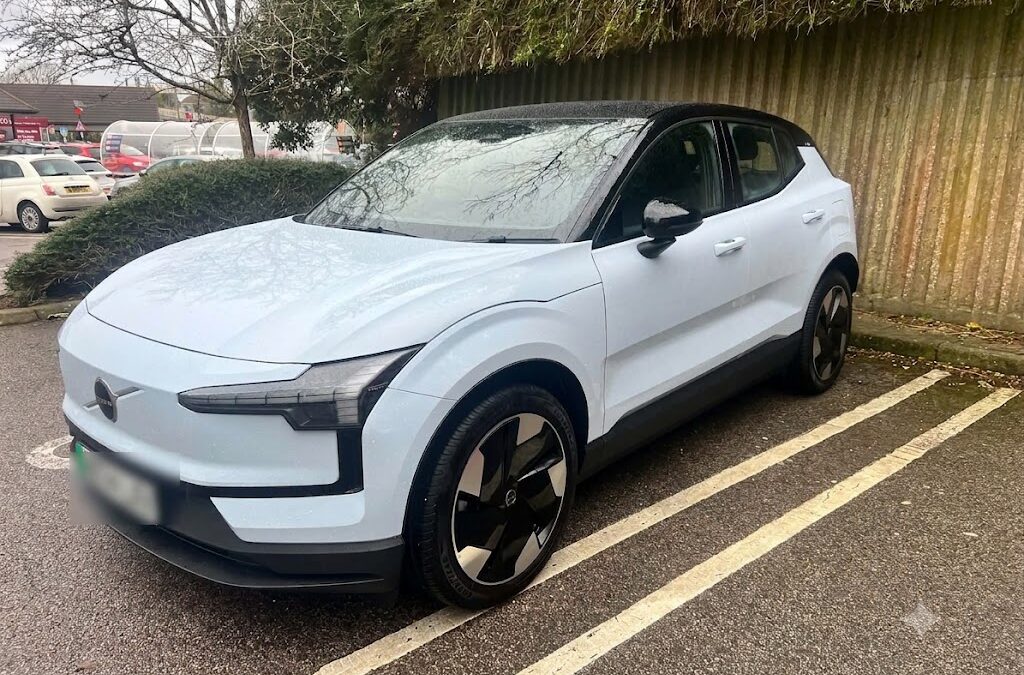
We have been at the forefront of reporting on the Volvo EX30 recall since before most mainstream media had even acknowledged there was a story to cover. We documented the original safety notice, the scale of the problem across 10,440 UK vehicles, the fire liability letters, and the months of poor communication that left thousands of owners with a capped battery, a £200 voucher and no confirmed date for a resolution. We published template complaint letters. We spoke to owners. We refused to let this issue get lost in all the noise.
Today we have the most significant development since the recall began. A confirmed Financial Ombudsman Service ruling upholding a complaint from a Volvo EX30 owner against Novuna Vehicle Solutions (Mitsubishi HC Capital UK PLC). The car has been collected. The agreement has been settled. A refund of nearly £3,000 has been received. And the FOS reasoning that got them there sets a clear precedent for every other EX30 owner still waiting in the dark.
The Background
The owner picked up their EX30 Twin Motor Performance Plus on 8th January 2025 on a three-year regulated lease agreement with Novuna Vehicle Solutions. On 29 December 2025, Volvo issued the safety recall notification linking a battery charging restriction to a risk of fire, with interim advice to limit charging to 70%.
Less than a year into a three-year agreement, the car they signed the agreement on was no longer fit for purpose.
Novuna rejected the formal complaint, offered £150 as a gesture of goodwill, and warned that exiting the agreement early would cost 50% of the remaining rentals. The owner took the case to the Financial Ombudsman Service.
The FOS investigator upheld the complaint in full.
What the FOS Found
The FOS confirmed that Volvo have identified a safety issue requiring the charging capability to be reduced to 70%. This constitutes a fault with the car that would have been present or developing from the point of sale. In its current state, the car cannot be used as intended.
The owner drives 80 to 100 miles each way five days a week and should be able to do this on a single charge. The restriction meant they could not. The FOS found this directly relevant and persuasive.
Critically, over six months had passed since Volvo made the owner aware of the issue with no confirmed date for when a fix would be available or when the car could be booked in. That delay was central to the FOS finding in favour of rejection rather than continued waiting.
The owner had been provided with a hire car in the interim from 30 April 2026. The FOS did not consider this adequate. The hire car was a lower specification (and much slower) single motor EX30, not the twin motor performance model the owner was paying for. Not the same car. Certainly not the same agreement.
The Outcome
The FOS recommended collection of the car at no cost to the owner, the agreement marked as settled with no further payments and the credit file amended, a pro rata refund of the advance rental deposit, 15% reimbursement of monthly rentals from January to April 2026, 10% reimbursement of rentals from May 2026 to settlement, simple interest at Bank of England base rate plus one percentage point on all reimbursements, and the £150 previously offered paid directly into a bank account of the owner’s choice.
The car has been collected. The agreement is closed. The owner has received a refund of nearly £3,000 covering the pro rata deposit and a reduction in monthly payments from January onwards, and is in the process of sourcing a replacement vehicle with delivery expected in September. It will not be another Volvo.
In the Owner’s Own Words
We spoke to the owner after the outcome was confirmed. They were happy, describing it as the outcome they would have wanted. They said they would have accepted a clean termination without any refund if it had come to it, but fought for reimbursement because ending a three-year agreement 18 months early was unplanned and sourcing a replacement lease costs money.
On advice for other owners, they were clear: use all means at your disposal.
The most significant thing they shared with us was this. During the FOS case, they provided links to Hypermiler.co.uk articles (as evidence to the investigator that the EX30 issue was not an isolated complaint but a documented problem affecting thousands of UK owners. The FOS investigator had access to our coverage as part of the evidence considered in reaching their decision.
On whether other owners should expect the same outcome: as they have ruled in my favour, I can’t see how they can deny anyone.
Volvo’s Continuing Poor Communication
It would be wrong to publish this article without addressing something that has made the EX30 situation significantly worse than it needed to be: the communication from Volvo has been consistently poor throughout.
Owners have been left for months with no update, no timeline and no clarity on when their specific vehicle will be fixed. What we are increasingly hearing from the EX30 community is that the loudest voices are being shuffled to the front of the queue. Owners who have complained repeatedly, escalated formally or made noise on social media appear to be getting their battery replacements scheduled ahead of those who have quietly waited as Volvo asked them to.
That is not how a recall should work. Every affected owner is equally entitled to a resolution, regardless of how loudly they have complained or how persistent they have been. If you have been quietly waiting and have not yet heard anything concrete from Volvo about a fix date, that is not a sign your car is not affected. It may simply be a sign that you have not yet applied enough pressure.
This is part of why the FOS route matters so much. It is a formal, regulated process that puts Novuna and other finance companies under a legal obligation to respond, and gives owners a legitimate escalation path that does not depend on whether they happen to shout loudly enough on Facebook.
A Note on Cash Buyers
We are acutely aware that not every EX30 owner has a finance company to complain to. Those who bought their cars outright do not have access to the FOS route, which applies specifically to regulated credit agreements. Their options are to pursue Volvo directly or raise concerns with Trading Standards.
The position of cash buyers is one of the most difficult and underreported aspects of the EX30 recall. We will be covering this specifically in a dedicated article. If you bought your EX30 outright and are struggling to get resolution, get in touch.
Why This Sets the Stage for Every Affected Owner on Finance
FOS decisions do not create binding legal precedent in the way a court ruling would. But what this ruling does is establish a clear, documented application of the Consumer Rights Act 2015 to the exact circumstances of the EX30 charging restriction. Every argument that succeeded here applies equally to every other affected vehicle on finance.
The fault was present or developing from the point of sale. The car cannot be used as intended. No fix has been provided within a reasonable timeframe. A lower-specification replacement hire car is not equivalent to the contracted vehicle. Goodwill compensation from Novuna was not sufficient.
These are not facts unique to one owner. They are the facts of the EX30 recall for every affected owner. The FOS has now applied the Consumer Rights Act 2015 to those facts and found in the owner’s favour. There is a documented, successful outcome to point to. And as the owner who achieved it told us, they cannot see how the FOS can deny anyone.
We are also aware of at least one separate case where the finance company initially rejected the FOS investigator’s recommendation and the case went to a full Ombudsman determination. The owner still won at the second stage. Pushing back does not change the outcome. It just delays it.
What to Do If Your EX30 Is Affected
Your complaint goes to your finance company, not Volvo. Under a regulated PCP or lease agreement, the finance company is responsible for the quality of the goods under the Consumer Rights Act 2015.
Write formally. Set out your daily mileage requirements and explain why the 70% charging restriction prevents the car from meeting them. Reference the Consumer Rights Act 2015 and the implied term that goods must be of satisfactory quality and fit for purpose. Cite the official safety recall and note the fault would have been present from the point of sale. State that no confirmed fix date has been provided within a reasonable timeframe. Request rejection and a full unwinding of the agreement.
Include links to coverage documenting the scale of the recall. As this case demonstrates, showing the FOS that this is a systemic, widely documented issue rather than an isolated complaint strengthens your case. Our full Volvo EX30 coverage is available here and has already been used as evidence in a successful FOS complaint.
Give the finance company eight weeks to respond. If they reject your complaint or go quiet, take the case to the Financial Ombudsman Service at financial-ombudsman.org.uk. It is free to use.
We Will Keep Covering This
We started covering the EX30 recall because it was the right thing to do, and having an EX30 in our own fleet made the issue closer to heart. Thousands of UK owners were being failed by Volvo, mostly ignored by the mainstream press, and left to navigate a complex consumer rights situation without support or information. We have done what we can to change that.
This FOS ruling is the most significant development in the EX30 story since the original recall was confirmed. The Consumer Rights Act 2015 works (just as we explained in a previous article). The FOS will apply it against Novuna and other finance companies. And now there is a documented, successful case to point to.
If you have not yet raised a formal complaint with your finance company, do it now.
We will keep covering this until every affected owner has a resolution. Sadly, due to the limited number of Volvo service centres certified to swap batteries and the delays in shipping and manufacture, we fully expect some owners to be waiting for a fix over a year after the issue was first confirmed.
The FOS Ruling in Full
With the permission of the owner, we are publishing the key sections of the FOS investigator’s decision below. Personal details have been redacted. This is the document that Novuna Vehicle Solutions received and that led to the outcome quite rightly deserved.
Complaint about Mitsubishi HC Capital UK PLC trading as Novuna Vehicle Solutions
We now have all the information we need to look into this complaint. Based on what I have seen, I don’t think Mitsubishi HC Capital UK PLC (NVS) have acted fairly. I have explained why below, along with how I think the complaint should be resolved.
The complaint
The complainant is unhappy with the quality of the Volvo EX30 currently on lease with NVS and has asked to reject the car as there is an imposed charging restriction of 70% by Volvo due to safety concerns. He said the car can now not give him the range that was agreed when he entered into the agreement. Therefore, it is not what he agreed to. He would like to exit the agreement and have his payments back.
Background
On 8 January 2025 the complainant signed a regulated hire agreement with NVS to lease a new Volvo EX30 Twin Motor performance plus. An advance rental of £3,784.03 was paid and the agreement is for 35 monthly rentals of £315.34 which includes maintenance.
On 29 December 2025 Volvo issued a safety recall notification in connection with battery charging and risk of fire, they were working on a fix and the interim advice was to only charge the battery up to 70%, thus reducing the driving range achievable between charge.
Volvo gave affected customers a £200 charging voucher.
A complaint was raised with NVS on 12 January 2026. The complainant asked to reject the car or have a timescale for repair and reduction in rentals. NVS issued a final response on 24 February 2026. NVS said the safety recall doesn’t mean the car was faulty and if the complainant wanted to exit the agreement early there would be a 50% fee of the remaining rentals outstanding. £150 compensation was given as a gesture of good will. The complaint was not upheld.
Unhappy with this response the complaint was referred to our service on 24 March 2026 for an impartial review.
Since then, on 30 April 2026 the complainant was provided with a hire car to use on a rolling 28-day contract. The complainant says this doesn’t solve the issue. The hire car he has is still an EX30 but a lower spec single motor version. Not the same as the car he is currently paying for.
My investigation
I have considered all the available evidence and arguments to decide what is fair and reasonable in the circumstances of this complaint.
In considering what is fair and reasonable, I need to have regard to the relevant law and regulations, regulators’ rules, guidance and standards, codes of practice and (where appropriate) what I consider to have been good industry practice at the relevant time.
The agreement in this case is a regulated consumer credit agreement. As such, this service is able to consider complaints relating to it. NVS is also the supplier of the goods under this type of agreement, and responsible for a complaint about their quality.
The Consumer Rights Act 2015
The Consumer Rights Act 2015 is of particular relevance to this complaint. It says that under a contract to supply goods, there is an implied term that the quality of the goods is satisfactory.
The Consumer Rights Act 2015 says the quality of goods are satisfactory if they meet the standard that a reasonable person would consider satisfactory taking into account any description of the goods, the price and all the other relevant circumstances. So it seems likely that in a case involving a car, the other relevant circumstances a court would take into account might include things like the age and mileage at the time of sale and the vehicle’s history.
The Consumer Rights Act 2015 says the quality of the goods includes their general state and condition and other things like their fitness for purpose, appearance and finish, freedom from minor defects, safety, and durability can be aspects of the quality of goods.
About the car
NVS supplied the complainant with a new car and there is a greater expectation on quality and reliability on a new car.
Is there something wrong with the car?
Volvo have confirmed that there is a safety issue with this car, and the interim advice while waiting for a fix to be implemented is to reduce the charging capability to 70%.
Satisfactory quality
We would consider that this is a fault with the car and it would have been present or developing from the point of sale. Therefore, the car in its present state can’t be used as intended.
While under CRA 2015 the supplying dealer (SD) is entitled to offer repair, this needs to be provided in a timely manner. It is now coming up to six months since Volvo made the complainant aware of the issue and despite the complainant’s best efforts to chase an update from all parties. There is no fixed date of when the replacement battery will be available or for the car to be booked in for the battery to be replaced.
Therefore, I think the complainant is within his rights to ask for rejection. As even though he has been provided with alternative transport to keep him mobile it is not the leased car he agreed to.
My findings
The complainant has explained he drives 80 to 100 miles each way five days a week. He should be able to do this in a single charge but due to the restriction he has to make charging stops.
I can see that the complainant has asked for his deposit back and all payments, but our service would not support that, as we wouldn’t advocate free use of a car. And the complainant was able to use the car problem free for the first 12 months.
From the end of December 2025 to 30 May 2026 the complainant was able to use the leased car but it was restricted by the maximum 70% charge. So, I think it would be fair for NVS to reimburse 15% of monthly rentals between January 2026 and April 2026.
The complainant was then given a hire car but it was not the same specifications so I think it would be fair for NVS to reimburse 10% of rentals from May 2026 until Settlement.
With lease agreement the advance rental amount reduces the monthly payments over the term of the agreement. Without it the complainant would have been paying more than £315.34 a month. Therefore the complainant is not entitled to have the full advance rental payment back but a pro rata refund should be applied.
How to put things right
Taking everything into account I uphold this complaint and recommend NVS take the following action:
- Arrange collection of the leased car at no cost to the complainant
- Once collected the agreement should be marked as settled with no further payments owing. And the credit file amended to reflect this.
- The hire car supplied will then also need to be returned to the rental company.
- A pro rata refund should be reimbursed of the advance rental payment.
- 15% of rentals reimbursed from January 2026 to April 2026.
- 10% reimbursement of rentals from May 2026 to settlement.
- NVS should pay simple interest using time-weighted average Bank of England base rate plus one percentage point on the above reimbursement from the date paid until the date of settlement. If HM Revenue and Customs requires NVS to take off tax from this interest, NVS must give a certificate showing how much tax they have taken off if requested.
- The £150 compensation that NVS previously offered and said would be applied to the hire account, should be paid into a bank account of the complainant’s choice if this hasn’t already been done.
Next steps
I think this is a fair outcome in the circumstances, for the reasons I have explained. Please let me know by 25 June 2026 whether you agree to my recommendations so the case can be resolved.
But if you don’t accept what I have said please give your reasons by 25 June 2026 and provide any further evidence or information. Requests for more time must also be made by that date. If I can’t resolve the complaint or don’t hear from you by 25 June 2026 I’ll arrange for an Ombudsman to determine the complaint.
Let’s Hear From You
Are you an affected EX30 owner? Have you raised a complaint or received a fix date? Let us know in the comments below. Every piece of information helps us build a clearer picture and keep the pressure on.
Related reading:


I have my car though Tuskers Leasing and I have raised multiple complainst with them since the issue was identified. The first car i was given to use after I refused to drive my car was a peter Skoda, I said this was not acceptable as I brought an EV to lower my running costs. After aout one month this was changed to a New EX30, however, not the same spec as I am still paying for. I hve raised this several times without any changes being made by Volvo or Tuskers. I was told on the 28th April that mine was being treated as a Priority, however, since then no communication even when you write to Volvo and Tuskers asking for an update. I know someone who works in a Volvo garage and he has said i’t not likely to be done before Jan 27, that mean my car will be off the road for over 1 year. I will go back to FOS now and ask what they can do.
I bought a second hand 74 plate Volvo ex30 dual motor and have heard nothing from the dealership we bought from regards a fix.
I bought my EX 30 outright, and the same as everyone else I’ve experienced nothing but poor communication from Volvo. I have contacted Volvo Customer services on my occasions, what a waste of space they are, very polite, but that’s where their usefulness ends. They say contact the Ombudsman, ofcourse knowning they are snowed under and can’t deal with any case for months. The dealer isn’t much better saying it takes 3 days to complete the module swap, and they only have 1 qualified technician to complete the task. No communication on dates and over 40 cars to fix.
So if I’m at the of the que it’s should be resolved by late 2027 if I’m lucky. Totally not acceptable. I’ve resorted to using my Diesel van for long journeys!
I’m on a salary sacrifice via Lex Autolease and every avenue I’ve turned down has been a dead end. I’ve tried Volvo, they offered £200 voucher which I still haven’t received. I tried Lex Autolease who took 8wks to respond with a tuff, you just need to deal with it. I then took it to the ombudsman who also declined. They have all basically told me I need to wait and also keep paying 100% of my payment for 70% of a car. 10000 cars to be fixed…if every Volvo dealership fixed these every working hour of every operational day, it’s still take nearly 5yrs to do.
I pay a significant sum every month for this vehicle and not only is it a danger, it’s unworkable, yet I’ve just to get on with it. I’m so angry with their attitude, they simply do not care one bit. It’s unreal.
Never buying a Volvo again, and never using Lex Autolease again.
I have also had my complaint upheld by the FOS, very much the same outcome.
Not once did Novuna offer me a courtesy vehicle though.
Car is going back probably Friday. Happy Days
I bought my EX30 SM ER Ultra outright in October 2024. I foolishly expected that Volvo would behave honourably and waited patiently for updates. The only subsequent communication I received was threatening to invalidate the warranty because on a couple of occasions I charged beyond 70%.
I am now out of patience and have contacted the dealer to ask for an enhanced px against a XC40. I am tired of the inconvenience and expense caused by the restricted charging, and feel that the dealership and Volvo are treating their customers with contempt. That really grates when you’ve paid a lot of money in cash for a defective product.
I feel disadvantaged as a cash buyer.
My vehicle was £42k list price new, I’ve been offered £22k px value. Depreciation of £1k pcm! In large part due to the safety recall.
Despite the excessive depreciation, and the added inconvenience and expense of charging away from home, my dealership have told me they don’t understand why I think I’m entitled to an enhanced px value!
They have rejected my request to reject the vehicle as unfit for purpose.
I now have the added concern of the vehicle executing an emergency stop whilst I was driving in traffic. This has been rejected as “what the vehicle is designed to do”
I don’t feel safe driving this car. What can I do?
Also a cash buyer – twin motor performance ultra. I have a car my wife won’t drive, I have a car I can’t drive due to limited range and not a single call from the supplying dealer – Marshalls. Volvo just respond with boiler plate standard emails not listening or taking account of our specific circumstances. When I called Marshalls they sought to profit from the experience with a derisory offer to buy the car back…at an insult of a price – no offer of hire car (that would be impossible), compensation (there is nothing wrong with the car!!!!?!!!!) or the good grace to respond to subsequent emails… 10,440 customers let down! If lease customer are allow to return car so should cash buyers… paying only the per mile cost that a lease customer would have been charged for going over the stated mileage and the rest of their purchase price refunded.
I am one of those cash buyers you refer to above. Eight months in and still awaiting resolution. Yes, I gave the £200 voucher but am more worried about the impact on value.
4-year agreement with Volvo Finance, Sep-2024 for a brand new car. Deposit nearly 25%. Complained to Volvo Finance May-2026. Initially wanted evidence from me that the fault had existed from purchase (requested service records etc. – delaying tactics)! Offered a £200 charging credit which never materialised but which I have rejected. Also referred to an email that I’d allegedly sent (never emailed full stop) – suggests copy and paste from another complaint or template response without bothering trying to look at my case – or worse still, a Data Protection Breach. Complaint submitted to FOS last month and raised many points covered in the upheld case without having read the upheld case facts. Car now due for service but I have not arranged this, nor have I received an invitation for battery replacement. Fingers crossed for the right outcome.
my 24 plate Extended Range Plus was fixed under the recall on Monday of this week, it’s a salary sacrifice car – took 8 months of constant hassling, my company fleet dept, LEX (who have been awful) and Vovlo (who have been completely uninterested). I’ve started to go down the FOS route to recoup some of the cost of my salary sacrifice over the 8 months pre tax it’s over £700 a month. LEX very unwilling to cooperate with sending me a copy of the lease agreement, said it was an agreement between my employer and LEX. I have a copy now, I’ll let you know how I get on. I’ve heard that LEX may panic and offer me a settlement when FOS open the investigation, but not holding my breath.