
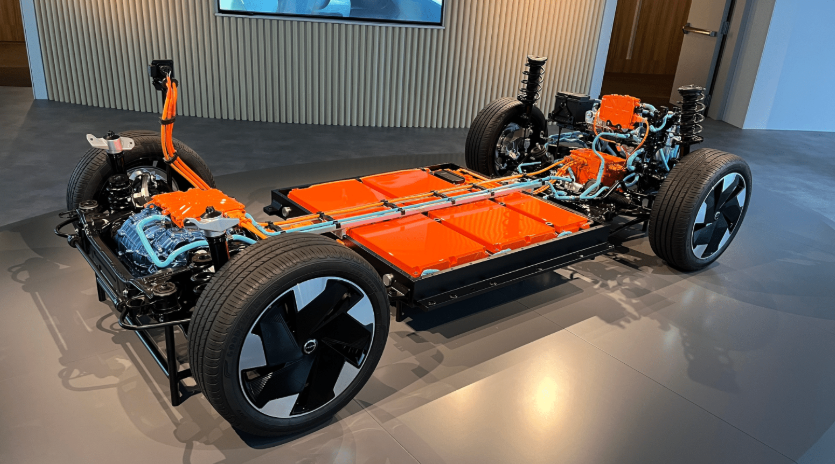
Volvo has confirmed that 10,440 EX30s in the UK are affected by a developing safety issue linked to Sunwoda‑supplied high‑voltage battery cells, marking the first time the scale of the problem has been acknowledged publicly.
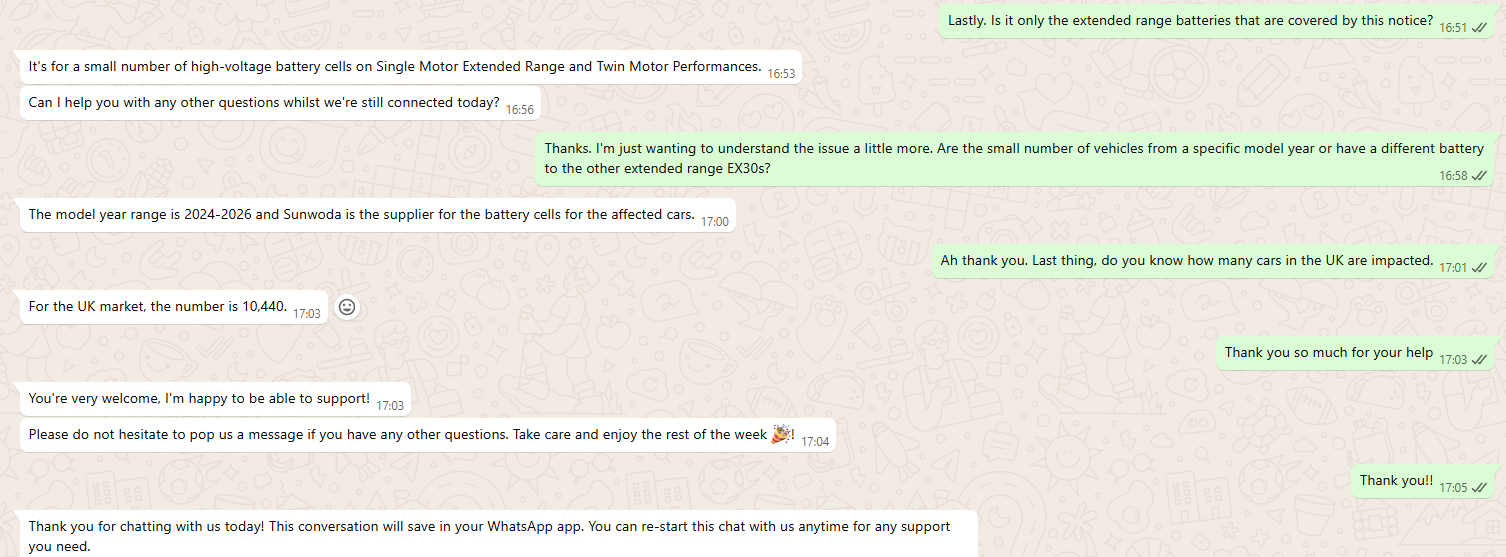
The confirmation came during a WhatsApp customer support exchange by Hypermiler on New Year’s Eve, where Volvo stated that its internal quality‑follow‑up systems had identified a potential defect in battery cells used in Single Motor Extended Range and Twin Motor Performance variants. The affected vehicles span model years 2024–2026, all equipped with Sunwoda’s extended‑range pack.
Volvo has instructed owners not to charge their vehicles above 70% until a permanent fix is identified. According to the company, keeping the state of charge below this threshold “significantly reduces” the likelihood of the issue occurring. A formal notice is expected once Volvo completes its investigation with regulators.
EX30 Battery Fire
Update – since publishing this article, we have been made aware of an incident in Brazil in which an EX30 caught fire. You can read more about that below.
A spotlight on Sunwoda’s battery quality problems
The timing of Volvo’s confirmation intersects with broader scrutiny of Sunwoda’s manufacturing standards. In late December, Geely — Volvo’s parent company — filed a $323 million lawsuit against Sunwoda over alleged large‑scale battery quality failures, including defective cells, rejected batches, and production inconsistencies that reportedly forced Geely subsidiaries to halt or rework vehicle builds.
While the lawsuit does not specifically reference the EX30, it paints a picture of systemic quality‑control weaknesses within Sunwoda’s production lines. For a supplier responsible for high‑volume EV battery output across multiple brands, the allegations raise questions about manufacturing discipline, cell‑level reliability, and the robustness of Sunwoda’s internal testing regimes.
Industry analysts have noted that the EX30 issue — described by Volvo as involving “a small number of high‑voltage battery cells” — aligns uncomfortably with the types of defects highlighted in Geely’s claim. Although no direct link has been established, the overlap in timing and supplier identity places Sunwoda under intensified scrutiny.
Owners left waiting for a formal remedy
For now, EX30 owners must operate with a reduced usable range while Volvo finalises its technical response. The company maintains that the risk remains rare, but the temporary 70% charge cap affects day‑to‑day practicality for many drivers.
A full recall or service campaign is expected once investigations conclude. Volvo’s confirmation of the 10,440‑vehicle UK impact provides the clearest indication yet of the scale of the issue — and places renewed attention on the battery‑quality challenges facing one of the EV industry’s most important suppliers.
How will this be fixed?
Volvo has been here before. During the earlier recall involving LG‑supplied PHEV battery modules, the company didn’t automatically replace entire packs. Instead, retailers used a diagnostic process to check each car for cell‑level deviations. Vehicles that passed the test received a software update designed to monitor the battery more closely, while those showing abnormalities had the affected modules replaced rather than the full high‑voltage unit. It was a targeted, engineering‑led approach that balanced safety with practicality.
Given the similarities — both issues involving specific cells within larger packs, and both presenting risk when the vehicle is parked at high charge — it’s reasonable to expect Volvo may take a comparable route with the EX30. Until the investigation concludes, nothing is confirmed, but a strategy built around VIN‑based diagnostics, software monitoring, and module‑level replacement would align with how Volvo has handled battery defects in the past.
You can read more about that below
Is your EX30 at risk?
Given the scale of the issue and the lack of a formal public notice so far, we strongly recommend that EX30 owners contact Volvo directly to confirm whether their vehicle is affected. Even if you haven’t received an email, Volvo’s customer‑service teams can check your VIN against the affected batches and provide the latest safety guidance. Acting early ensures you’re not unknowingly driving with a restricted‑charge advisory or a battery pack that may require inspection.
To make that process easier, we’ve published a detailed guide on how best to reach Volvo about potential EX30 battery risks, including the most responsive contact routes and what information to have ready when you call.
You can read it here:
The Source
For those wanting to read the WhatsApp messages from Volvo, please see the image below. This is a screenshot of OUR conversation with Volvo. In this conversation ,then confirmed that our “Standard” non-extended range 2025 EX30 was not at risk.


Thanks for doing the research and sharing
Received the email from Volvo re the potential fire risk and I am currently charging to 70%. Spoke to Volvo regarding timescales and was utterly underwhelmed at the lack of awareness of the impact this is having on households.
Let me explain. We are a household of 3 EV’s 2 of which are relatively short commutes but my Volvo doing a bit further commute I opted for the extended range Volvo over both BMW and Audi options.
I find now that rather than getting 2 to 2.5 days between charge I am having to charge daily. This is impacting us because on an off peak challenge, we are having to either charge at peak times or at public chargers.
With no apparent movement since the recall was introduced I suspect Volvo are at a loss as to what to do next.
If we accept the £200 does that mean we cannot take further action against Volvo?
Our car has less than 12 months on the lease so if we are going ot use it, we woudl like to activate it soon.