
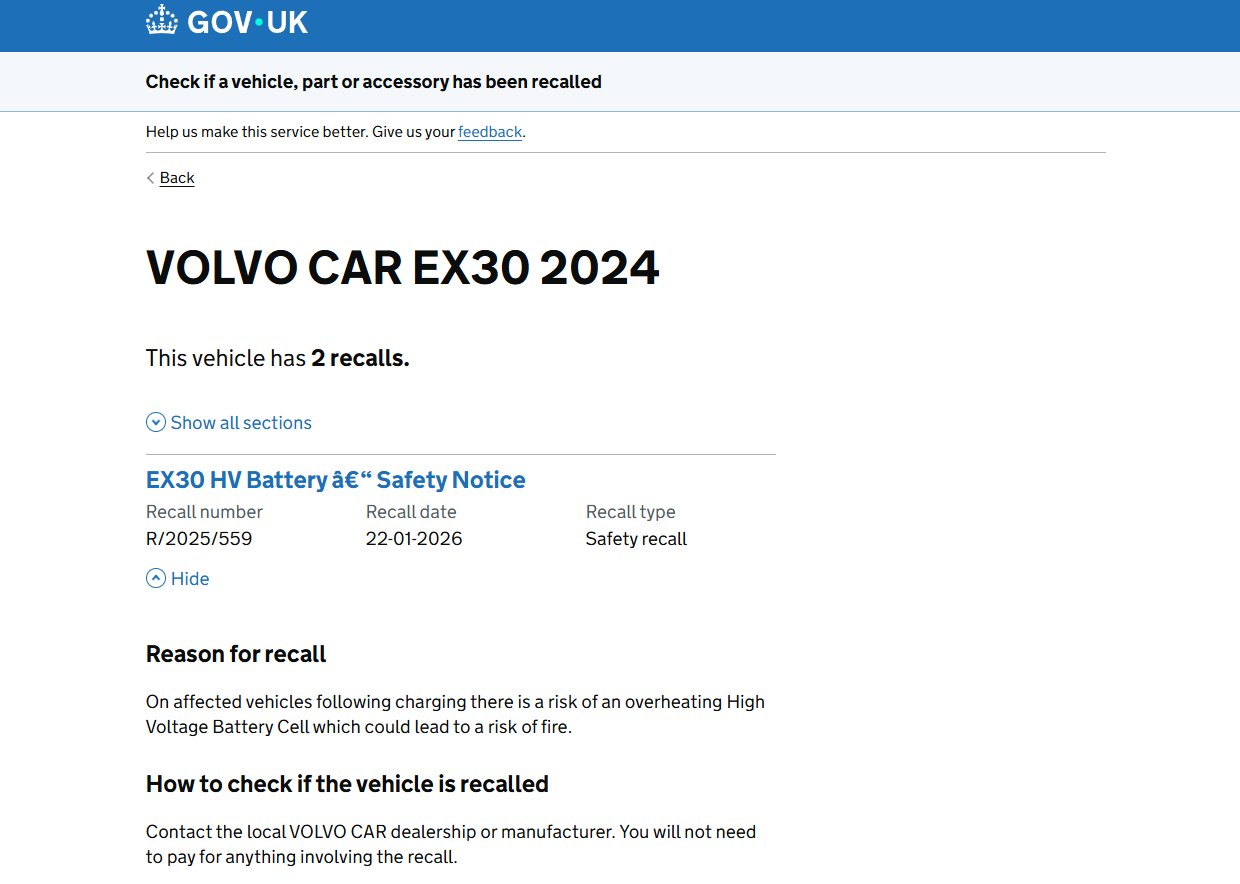
The UK government has finally confirmed the safety recall for the Volvo EX30, covering 2024 and 2025 models fitted with the extended‑range battery pack. The listing puts the total number of affected cars at 10,440, which matches what many suspected for months. And credit where it’s due: Hypermiler was the first to spot and confirm that figure, long before Volvo or the DVSA made anything public.
It’s taken a long time to get here. Owners have effectively been living under recall conditions since late 2025, stuck with a 70 per cent charge cap and very little clarity. The official listing is progress, but it doesn’t magically fix the situation or answer the questions people have been asking for months.
Here’s the link to the recall.
- Volvo EX30 2024 – https://www.check-vehicle-recalls.service.gov.uk/recall-type/vehicle/make/VOLVO%20CAR/model/EX30/year/2024/recalls
- Volvo EX30 2025 – https://www.check-vehicle-recalls.service.gov.uk/recall-type/vehicle/make/VOLVO%20CAR/model/EX30/year/2025/recalls
The recall as follows:
VOLVO CAR EX30 2024 / VOLVO CAR EX30 2025
This vehicle has 1 recall.
EX30 HV Battery Safety Notice
- Recall number R/2025/559
- Recall date 22-01-2026
- Recall type Safety recallHide
Reason for recall
On affected vehicles following charging there is a risk of an overheating High Voltage Battery Cell which could lead to a risk of fire.
How to check if the vehicle is recalled
Contact the local VOLVO CAR dealership or manufacturer. You will not need to pay for anything involving the recall.
How the manufacturer will repair
Volvo Cars is confident that limiting the battery’s maximum state of charge to 70% will eliminate the risk of overheating. Additionally we would advise the following precautions where possible: • Do not leave your vehicle unattended whilst charging within buildings or covered areas • If you see any vehicle warnings in the car or app during or after charging seek assistance Currently the investigation is still ongoing with the final service solution being developed.
Number of affected vehicles
10440
How We Got Here
The whole thing really escalated after the EX30 fire on 6 November 2025. That incident appears to have been the moment Volvo realised the battery issue wasn’t going away. By late December, they’d filed a lawsuit against Sunwoda, the supplier behind the affected battery modules. Only a few days after that, customers finally received the first notice telling them to limit charging.
That was all in 2025. We’re now into late Janurary 2026, and owners are still waiting for a proper explanation of what the long‑term fix actually is.
What the Recall Actually Says
The recall centres on the high‑voltage battery and the risk of overheating when charged to a high level. Volvo’s official guidance hasn’t changed much since the first advisory. They say they’re confident that keeping the battery capped at 70 per cent removes the risk. They also advise avoiding unattended charging in enclosed or covered spaces, and to seek assistance if the car or app shows any warnings during or after charging.
And here’s the part that doesn’t sit well with a lot of owners: none of that additional safety advice appeared in the letter Volvo sent out. The only communication most people have received simply told them to limit charging to 70 per cent. No mention of avoiding charging in buildings. No mention of not leaving the car unattended. Nothing about warning signs to look out for.
For a safety recall involving a potential fire risk, that’s a concerning omission. Owners deserved the full picture, not a watered‑down version.
The Real‑World Impact on Owners
The 70 per cent cap has been a genuine problem for a lot of people. On paper, it sounds manageable. In reality, it’s a daily compromise. Commutes that used to be simple now require planning. Longer journeys are a chore. Cold weather makes the range even worse. The car just doesn’t deliver what people paid for.
Some leasing companies have stepped in and provided replacement vehicles, which tells you everything you need to know about how disruptive this has become. Volvo has offered £200 charging vouchers in a few cases. It’s something, but it doesn’t restore the missing range or address the uncertainty hanging over owners.
The Communication Problem
The communication gap is still the biggest issue. Owners aren’t asking for miracles. They just want clarity. Instead, they’ve had to rely on forums, Facebook groups, and the occasional dealer whisper to piece together what’s going on.
The recall listing doesn’t fix that overnight, but it does at least put the issue on official record. And that matters when you’re dealing with finance companies or trying to argue that the car no longer meets your needs.
What This Means for Your Consumer Rights
This is where things get more practical. An official safety recall changes the landscape for owners, especially in the UK where consumer law is fairly robust when you know how to use it.
Under the Consumer Rights Act 2015, a car must be of satisfactory quality, fit for purpose, and as described. A vehicle that has had its usable range cut by 30 per cent, and is under an open‑ended safety recall with no fix or timeline, raises questions on all three points.
If you bought the car outright or on PCP, you deal with the retailer, not Volvo. They’re the ones legally responsible for sorting things out. If the car is leased, your contract is with the leasing company, and they have a duty to provide a vehicle that meets the purpose you’re paying for.
A few points owners should keep in mind:
- A recall strengthens your position because the defect is now formally acknowledged.
- If the car no longer meets your needs due to the charge cap, you can argue it’s not fit for purpose.
- You can request a repair, replacement, or in some cases a price reduction or rejection, depending on your circumstances.
- Finance companies tend to take recalls seriously because they don’t want to be left holding a depreciating asset with an unresolved safety defect.
It won’t guarantee an easy conversation, but it gives you firmer ground to stand on.
More about your rights below
The Bigger Picture
The EX30 is a good car caught up in a very messy situation. The recall confirmation is a step forward, but only because the bar was so low. Until Volvo explains what the fix is, how long it will take, and what owners should expect, people are stuck with a car that can’t do what it was sold to do.
And that’s not something a voucher or a carefully worded statement is going to gloss over.
Let’s hear from you
And finally, it would be good to hear how this is playing out for real people. If you’re living with the 70 per cent charging limit, how is it affecting your day‑to‑day use? Are dealers or finance companies keeping you updated, or are you still in the dark like most owners? First‑hand experiences help build a clearer picture of what’s actually happening beyond the official statements.


I own outright a late 2024 EX30 Plus ER and have received the 70% guidance. I’ve contacted Volvo via WhatsApp and raised a formal complaint, but still no updates or timeline. I’m sure it will be resolved eventually, but, how long into the future and how will this reduce the value of my asset. Frankly, despite loving the car, I want to be shot of the aggravation and of Volvo’s terrible customer experience! Next stop the dealer who sold the car to bend their ear!
Update – offered the £200 charging voucher, but thats pretty useless tbh. It expires in 12 months, is selected places only, and I can’t use the car for long trips or high speed charging anyway. Called the dealer who sold me the car, they just tried to offer me a low px to buy another Volvo, needless to say where they can put that offer! Volvo have totally let us down, but dont worry they have just settled with Sunwoda for a shed load of cash – but I bet rather than give us new batteries, they will pocket it!
I too own outright a 2024 EX30 Plus ER. So far I have received x2 letters followed by matching emails, both outlining the issue but no mention of remedial action. I have called Volvo, and the dealership, as well as their unhelpful WhatsApp. After the second call to Volvo I was given a £200 charging voucher. Really concerned about the issue and subsequent impact on the value of my vehicle. I appreciate this is a worldwide issue but I’m amazed a company of this size and resource can’t respond quicker – approaching 6 weeks now since being informed my car has a serious fire risk!
6 weeks later and still no update from Volvo.
Not great customer service from a company that prides itself on “Safety” LOL
HI My name is Paul and I have received the Volvo recall notice 2 weeks late due to the wrong address on the envelope
I am really upset because I have multiple Hospital appointments to attend and normally charge my car at home using a 7 KWatt charger on low rate tariff from EON from 0001 to 0600 hours. So will experience much higher costs for charging no fault of my own.My Health is shot so can’t stand by it while it charges,
Informed Volvo and the leasing company and told to wait 2 weeks. No news from Volvo on a way ahead!!!!
Very frustrated and stressed out with a situation I am unable to do anything about.
The 70% charging restriction is doing my head in. I do a lot of driving and a 70% charge is just not cutting it. Called Volvo garage who said ; ‘we will be in touch when it is time for you to bring your car in’!!!! It is a leased company car so contacting leasing company now to see what they can do. Grrrrr!!!!
This is the best analysis I’ve seen. Thank you. I’m very indignant that this has been going on for two months now, with no fix and huge inconvenience on long drives. I won’t be buying a Volvo ever again.
One question: I bought my EX30 with a third of the cost covered by Volvo UK Finance 0% repayments. Am I legally entitled to suspend those payments until the solution is found? Continuing to pay for a dangerous car the manufacturers show no willingness to fix is very galling.
I have had a response from Volvo UK Customer Services…
“We are writing to you following the receipt of your complaint and aim to resolve your concerns as quickly as possible.
After our investigations have been completed, we will detail our findings and conclusion in a written response to you.
If our investigation takes longer than 4 weeks, we will be in contact with an update on your complaint and advise you on when we hope to conclude our investigation. If our investigations takes 8 weeks, we will provide you with an update on our investigation, the reason for the delay, and details of the Ombudsman Services.
If you are either dissatisfied with our final response, or 8 weeks have passed since you made us aware of your complaint, you can then ask the relevant Ombudsman Service to independently review the complaint.”
Basically, “go away”… no sorry for the inconvenience, no offer of the £200 charging credit, just “wait 4 weeks and if we haven’t responded in 8 weeks we’ll tell you how to contact the ombudsman!”
At least they’ve replied… I’ve had nothing from VCFS yet.
Tomorrow marks 7 weeks since I was first told not to charge above 70%… the lack of communication is really quite poor. The dealership I bought the car from are equally as in the dark as I am.
We have 24 plate EX30 ER. We took advantage of Volvos 0% finance. Chosen for its range, quality and company reputation, it must fulfil the need for long jorneys regularly. Its now costing increased time and money.
We need answers quickly and a fix from Volvo who are losing their credibility by the day. Also, issues like current and future value are definately going to leave us wanting………the dealer told us the trade in value is now 18K, so 38k paid in 2024 is now worth far less.
Im not laughing but this whole situation is a joke!