

A Volvo EX30 was completely destroyed after catching fire inside a dealership workshop in Maceió, Alagoas, on 6 November 2025. No injuries were reported, but the incident triggered a major emergency response: 11 firefighters and four fire engines were deployed to tackle the blaze before it spread through the building.
Witnesses described a sudden, dense cloud of smoke filling the workshop, visible even from across the busy avenue outside. The fire escalated quickly — consistent with the rapid progression seen in high‑energy battery failures. Although the official cause has not yet been confirmed, people at the scene reported early signs of a possible thermal runaway originating in the vehicle’s battery pack. The dealership has not commented.
This is the second EV fire in Brazil within a month, though the earlier case involved an improvised home‑charging setup and is not believed to be related. In contrast, the EX30 fire appears to have originated within the vehicle itself, adding another data point to the growing global scrutiny around the model’s battery behaviour.
At this stage, it remains speculation that the Maceió incident is connected to Volvo’s recent communication advising EX30 owners not to charge their vehicles beyond 70%. Volvo has not confirmed any link, and the investigation in Brazil is still ongoing. However, the timing has raised understandable questions among owners already concerned about the model’s battery stability.
What does align with emerging patterns is the number of EX30 drivers who say they were quietly told that a “vehicle fire” had prompted the temporary charging restriction. Until now, those claims lacked a clear reference point. The Maceió fire — occurring inside a controlled workshop environment and reportedly involving a suspected battery‑origin failure — fits the profile of the kind of event that could trigger a precautionary advisory, even if the official explanation has yet to surface.
It’s still early days
We’re still waiting for an official response from Volvo regarding the wider battery concerns and the recent charging restrictions. As soon as there’s something concrete to share, we’ll update this story. In the meantime, if you’ve had any communication from your dealer — whether it’s guidance, warnings, or anything that might help other EX30 owners — feel free to share it in the comments. Real‑world experiences are proving far more valuable than the limited information coming from official channels right now.
Update
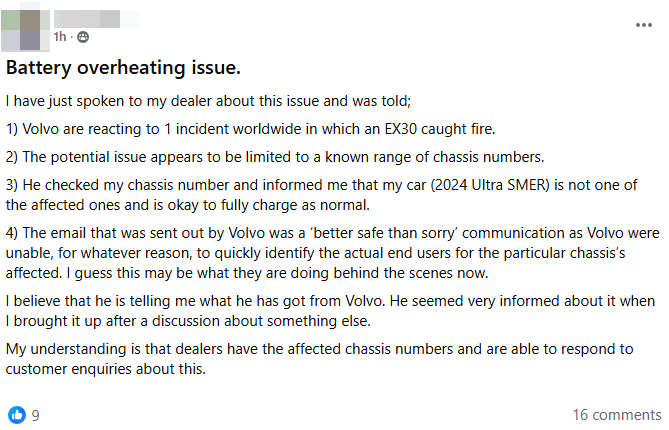
We’ve just seen this shared in the Volvo EX30 UK Facebook group, and it strongly suggests that this incident may be behind the recent battery‑charging guidance.. https://www.facebook.com/groups/2207539079450714
Thanks!
Thanks to user cpfc2010a and DrAlbin0 from the EX30 Reddit community for the heads up on this – https://www.reddit.com/r/ex30
News / Image Source https://canalve.com.br/carro-eletrico-pega-fogo-dentro-concessionaria-maceio-al/
Read more
-
Your Rights: Rejecting a Volvo EX30 on PCP When It Won’t Charge Above 70%
-
EX30 Battery Concerns Echo Earlier Volvo Recall Over LG Cell Defects
-
Volvo confirms 10,440 EX30s at risk due to Sunwoda extended‑range battery packs
-
How to best to contact Volvo about your EX30 battery if you haven’t recieved an email


This is the full text of the Volvo customer safety notice I received on 29/12/2025 relating to my Single Motor Extended Range EX30:-
Volvo
Important- Vehicle Safety Notice
Hello Belinda,
VIN: YV12ZEL80SS122629
Registration Number: OV74LFZ
Manufacturer ref: R10355
Volvo’s quality follow-up procedures have identified a potential safety concern with a small number of EX30’s Single Motor Extended Range and Twin Motor Performance. We understand from our records, that you are the current registered keeper of a vehicle with the registration detailed above. Therefore, please read the information within this letter as it will explain the issue and provide full details on the action that you need to take.
What is the issue?
Investigations have identified potential overheating of a High Voltage Battery cell. This could lead to a possible fire within the high voltage battery. It is possible that if overheating does occur a message within the Driver’s Information Module as below appears.
Image of safety message in Driver’s Information Module
What are we doing to resolve?
Volvo takes this situation very seriously and is working with the appropriate authorities to launch an effective action as quickly as possible. You will receive further communication regarding the solution as soon as it is available.
What you should do now?
Do not charge your battery above 70%
Set the maximum charge limit to 70%.
1. Press the vehicle symbol in the bottom bar in the Infotainment screen and go to Settings.
2. Go to Charge > Select Custom option.
3. Set your charge level to maximum 70%
If you have any questions
If you have any questions regarding this notification, please contact the Volvo Customer Relations Team on 01628 422522 and quote the manufacturer reference number detailed at the top of this letter.
Your safety and continued satisfaction with your Volvo are very important to us. We apologise for any inconvenience this may cause and appreciate your co-operation.
If you are not the owner or are not responsible for the vehicle, please forward the content of this email to the new owner or the person who is responsible for the vehicle.
Yours sincerely,
Phil Moody
Head of UK Customer Care
Please do not reply to this email. If you’d like to get in touch with us, please click here.
Please see our Privacy Policy. To find out more about Volvo Cars, click here.
View it online instead.
Volvo Car UK Limited
Scandinavia House, Norreys Drive, Maidenhead, Berkshire, SL6 4FL
I wouldn’t post the VIN