The AdBlue warning light on a VAG diesel is one of those dashboard messages that makes people panic. It should not, as long as you understand what it is telling you and act before the countdown runs out. Here is everything you need to know, kept short and to the point.
What is AdBlue?
AdBlue is a urea-based fluid injected into the exhaust system to reduce harmful nitrogen oxide (NOx) emissions. It is stored in a separate tank, usually filled via a blue cap near the fuel filler or in the boot. The system is called Selective Catalytic Reduction, or SCR.
It is worth noting that VAG diesel emissions are something we have covered extensively on this site. If you are a VW, Audi, Skoda or Seat diesel owner, you may want to read our Dieselgate coverage which details how the emissions fix affected thousands of UK owners and the EGR and DPF failures that followed.
What does the warning sequence look like on VAG diesels?
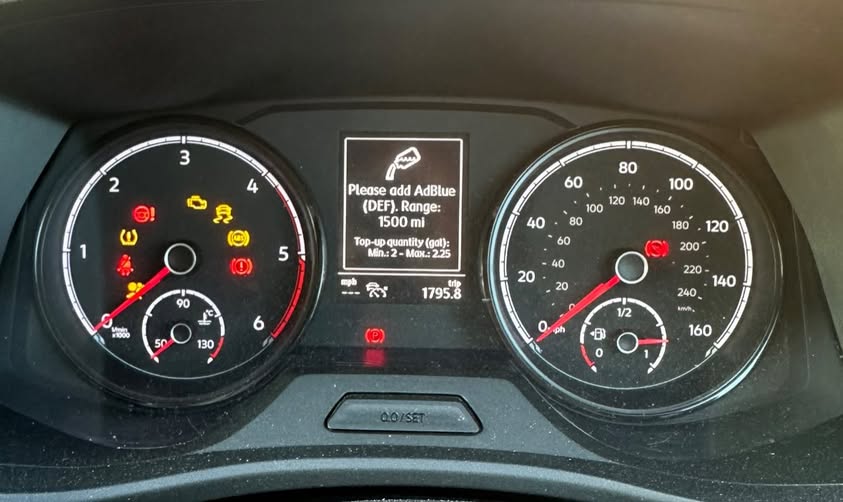
1,500 miles remaining: An amber message appears on the dashboard. It repeats every 62 miles. You have plenty of time to top up.
1,000 miles remaining: The amber message becomes more frequent, appearing every 31 miles. Still no emergency but top up soon.
Below 1,000 miles: The warnings intensify. The message will tell you exactly how many miles you have before the engine will not restart.
Zero AdBlue: The car will complete your current journey but will not restart. You cannot drive it until the AdBlue tank has been topped up and the system has reset.
This is not a suggestion. Modern VAG diesels are programmed to prevent the engine from starting if the AdBlue tank runs empty. It is a legal emissions compliance measure.
Which VAG models does this affect?
This applies across the whole Volkswagen Group diesel range. On the VW side that includes the Golf, Polo, Passat, Tiguan, Touran, Touareg and Transporter T5, T6 and T6.1. Audi owners will see the same warning sequence on the A3, A4, A5, A6, Q3, Q5 and Q7. Skoda models affected include the Octavia, Superb, Kodiaq, Karoq and Yeti. And on the Seat side, the Leon, Ateca, Tarraco and Alhambra all use the same SCR architecture. If you drive a 1.6 TDI, 2.0 TDI or 3.0 TDI across any of these models, the warning sequence, top-up procedure and common faults covered here will apply to your car in exactly the same way.
How do I top up AdBlue correctly?
AdBlue is widely available from motor factors, Halfords, supermarkets and online. Most VAG passenger cars take between 17 and 20 litres in a full tank. You do not have to fill to the brim, but always add at least 5 litres for the system to register the top-up.
The correct top-up procedure for VAG vehicles:
- Turn the ignition on without starting the engine
- Wait 30 to 60 seconds for the system to initialise
- Add at least 5 litres of AdBlue
- Turn the ignition off
- Turn the ignition on again and wait another 30 seconds
- Start the engine
If you top up without following this sequence the system may not register the new fluid and the warning will remain. Do not overfill. Overfilling the AdBlue tank causes the level sensor to read incorrectly and can trigger the same warning light you are trying to clear.
Why does the warning stay on after I have topped up?
If your AdBlue light won’t go off after a correct top-up, the issue is not the fluid level. This is one of the most common questions we get asked, often alongside how long can I drive with the AdBlue light on before the car refuses to start. The honest answer depends on the cause. A genuine VAG AdBlue fault, rather than a simple low-fluid warning, needs proper diagnosis rather than another trip to the AdBlue pump. Common causes include:
Faulty AdBlue level sensor. A relatively common fault on VAG diesels, particularly after high mileage. The sensor reads incorrectly even when the tank is full.
Failed AdBlue pump. The pump that injects fluid into the exhaust can fail, particularly on vehicles with low mileage where the pump has crystallised from infrequent use.
NOx sensor fault. A failed NOx sensor will trigger an AdBlue system warning regardless of fluid level and will set a P20EE or P204F fault code.
AdBlue injector blockage. The injector that sprays fluid into the exhaust can block, particularly if degraded or contaminated AdBlue has been used.
All of these require a diagnostic scan with dealer-level or VCDS equipment to identify. None of them can be fixed by topping up.
How much AdBlue does a VAG diesel use?
A typical VW Group passenger diesel uses around 1 litre of AdBlue every 350 to 600 miles depending on driving style and engine. Harder driving and more motorway miles produce more NOx, which means the SCR system injects more AdBlue to compensate. Most owners will need to top up once between services.
On VAG vehicles, AdBlue is not typically included in a standard service. It is a consumable you manage yourself between visits, similar to screen wash.
Is it legal to disable or remove AdBlue?
No, and this is worth being completely clear about. If you have searched “AdBlue delete legal UK” and found forum posts or tuning shops suggesting otherwise, ignore them. Disabling, removing or bypassing the AdBlue system on a VAG diesel is illegal in the UK. The SCR system is a legally mandated emissions control device. Tampering with it is a criminal offence under the Road Vehicles (Construction and Use) Regulations, and it will result in an automatic MOT failure. An emissions-tampered vehicle can also invalidate your insurance, since you are no longer driving a vehicle that complies with its type approval.
There is a thriving but entirely illegal market in AdBlue delete remaps and EGR, DPF and AdBlue removal kits, often advertised by tuning shops and online forums as a way to avoid the cost and hassle of failed sensors or expensive components. We would strongly advise against this route. Beyond the legal exposure, a vehicle with AdBlue removed will fail its MOT outright under the rules covering emissions tampering, and many insurers now ask directly whether emissions equipment has been modified. A claim could be refused entirely if it later comes out that the system had been bypassed.
It is also worth remembering the irony here. The entire reason VAG diesels were forced into this AdBlue architecture in the first place was Dieselgate, after VW was caught using a defeat device to cheat emissions tests. Removing AdBlue is effectively trying to repeat that same con on a smaller, personal scale, and the legal and financial risk sits entirely with the owner rather than the manufacturer this time.
If your AdBlue system has a genuine fault, the right route is diagnosis and proper repair, not removal. It is often expensive, which we understand is frustrating, but it is the only legal option.
Does this relate to Dieselgate?
Yes, and it is worth understanding the connection. The AdBlue SCR system was VW’s response to the emissions scandal. Before Dieselgate, many of the affected EA189 engines did not use AdBlue at all. The defeat device allowed them to cheat NOx emissions tests without it. After the scandal, newer VAG diesels were engineered with proper AdBlue systems as a genuine emissions control measure rather than a workaround.
If you had the EA189 emissions fix applied to an older VW, Skoda, Audi or Seat and have since experienced EGR, DPF or fuel system problems, you are not alone. We covered this extensively. Our Dieselgate coverage includes survey results from over 3,000 affected owners, alongside our investigation into how the fix affected DPF filters, EGR valves and fuel efficiency across the VAG range.
Is AdBlue the same as DEF?
Yes. If you have come across the term DEF, short for Diesel Exhaust Fluid, this is simply the American name for exactly the same product as AdBlue. Same 32.5% urea solution, same SCR process, same purpose. AdBlue is a registered trademark used predominantly in the UK and Europe, while DEF is the generic term used in the US and other markets. If your car’s manual references DEF, or you have seen the term used in American forums or YouTube videos while researching a fault, you can treat all of the advice in this guide as applying equally. There is no difference between the two beyond the name.
The short version
Top up with at least 5 litres. Follow the ignition cycle procedure. Do not overfill. If the warning does not clear, get a diagnostic scan before the countdown reaches zero. Never disable or remove the system. A car that will not start because of empty AdBlue is a straightforward fix. A car stranded miles from home because you ignored the warning is not.
Have you had AdBlue issues on your VAG diesel? Let us know in the comments.
Related reading: