
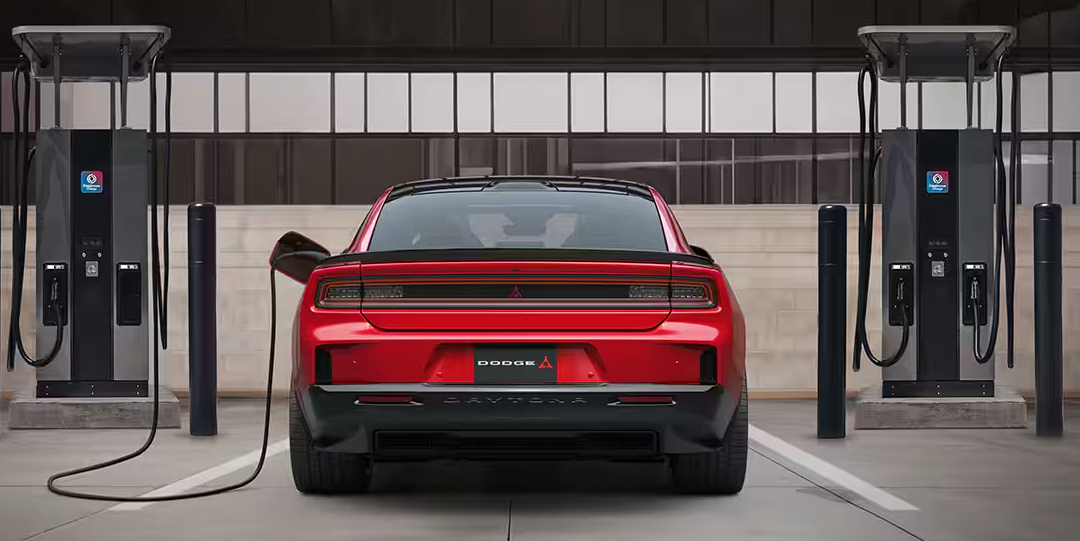
A video landed in youtube subscriptions today that I could not look away from. Cleetus McFarland and the crew flew to Miami, walked into a Dodge dealership, and bought a brand new Dodge Charger Daytona EV Scat Pack for 50% off the sticker price. The car had been sitting on the lot for 410 days.
They hated it.
Not mildly disappointed. Genuinely, vocally, repeatedly hate it. The fake exhaust sound drove them insane. The donut mode barely worked. The roof glass cracked on the second day. Cleet, a man who has bought and destroyed more cars than most people have owned, said it was the worst video idea they had ever had and that he had never genuinely hated a car before.
The comments section agreed. One viewer summed it up perfectly: “George paid nothing and still got ripped off.”
So is the Dodge Charger Daytona EV actually the worst car in America? And what does any of this mean from a UK standpoint?
What Is the Dodge Charger Daytona EV?
For context, the Charger Daytona EV is Dodge’s attempt to take one of the most iconic muscle car nameplates in American automotive history and electrify it. The Charger has been a V8-powered rear-wheel drive muscle car since 1966. Fans of the original were already nervous when Dodge announced it was going electric. They were right to be nervous, but perhaps not for the reasons they expected.
The Scat Pack variant produces 670 horsepower in PowerShot and Drag mode, with a claimed 0 to 60mph time of 3.3 seconds. That is genuinely quick, quicker than the old Hellcat Redeye it replaces on paper. It has a 100.5 kWh battery pack, charges at up to 183 kW and can go from 20% to 80% in roughly 24 minutes. The claimed range is 241 miles, though real-world figures under enthusiastic use will be considerably less.
On paper, those numbers are not embarrassing. So what went wrong?
The Problem Is Not the Spec Sheet
Having watched the full video, the issues are not about the numbers. They are about the experience.
The fake exhaust sound system is the most divisive element. Dodge fitted external speakers to simulate the noise of a muscle car. In isolation this might seem like a fun novelty. In practice the sound is described as infuriating, like a Super Nintendo game, and the crew said it was driving them insane within minutes. The video ends with someone seriously suggesting they disconnect the speaker wires before they go mad.
The interior is big but the materials feel inconsistent for a car starting at around $62,000 and hitting nearly $80,000 with the Scat Pack and options. The donut mode, a headline feature, struggled to work as advertised on their test. The roof glass appeared to crack within 24 hours of ownership.
Most damningly, none of them could feel the 670 horsepower in the way they expected. The car weighs around 6,000 pounds. All that power is filtered through traction control systems that prevent the car from behaving like a muscle car at all. When the car finally produced some tyre smoke it was almost accidental.
As one commenter put it: “That $78,000 is the best $39,000 you could ever spend on a $15,000 car from the dealer.”
The Sales Figures Tell Their Own Story
The 50% discount is not a one-off negotiation success. It reflects a genuine commercial problem for Dodge. There are reportedly nearly 11,000 Charger Daytonas for sale across the US and they are not moving. Cars have been sitting on dealer lots for over 400 days unsold. For 2026 Dodge cut the Scat Pack starting price from over $75,000 to under $60,000, a reduction of nearly 25% in one model year.
Dodge sold just 1,947 units of the electric Charger Daytona in the first quarter of 2025, compared to 11,371 Challenger coupes in Q1 2023. That is a collapse of more than 80% in sales volume. In fact, in the first quarter of 2026 the electric Charger had only sold 240 units. That is not a slow-selling car. That is a car the market has almost completely rejected
That kind of price correction on a brand new car is extraordinary. Manufacturers do not slash prices by 20 to 25% unless the market has comprehensively rejected the product at the original price point.
Watch the video here
From a UK Standpoint: Would It Even Work Here?
The Dodge Charger Daytona EV is not officially sold in the UK (thank god!). It is built for the American market, rides on American roads, and is priced in dollars. But it is worth asking whether it would find an audience here if it were.
My honest view: no, and not primarily because of the price.
The car is enormous. At over 206 inches long and 84 inches wide (5.2m long and 2.1m wide), it would be borderline undriveable on most UK roads, impossible to park in most UK car parks, and would struggle with the width restrictions on countless country lanes. American muscle cars have always had this problem in the UK and the Daytona is wider than most. As you might already know, I’m the proud owner of a VW Transporter T5, and the Charger is longer and wider than the van, which is a pain to park, especially if you’re attempting to park in a multi-storey car park.
The claimed 241 miles of range is adequate by US standards where charging infrastructure is sparse and long straight motorways are the norm. In the UK, 241 miles of real-world range in a 6,000 pound car driven with any enthusiasm would realistically translate to somewhere under 200 miles, which in 2026 is behind what a BYD Atto 2 can deliver at a fraction of the price.
Also take into consideration that it has a massive 100.5 kWh battery pack. Even with the “claimed” 241 miles, it’s over double that of my EX30 battery, offering just 30 miles of extra range when comparing manufacturers’ figures. That’s unbelievable.
And the price. Even at 50% off in the US, the Charger Daytona Scat Pack cost $39,485. At current exchange rates that is approximately £31,000. For that money in the UK you have the BYD Seal, the Tesla Model 3, the Peugeot e-308 GT, and shortly the Vauxhall Corsa GSE with 281PS. Every one of them fits on a British road and every one of them I would chose over the Charger in a heart beat!
Is It Actually the Worst Car in America?
Probably not. The worst cars in America are usually the ones nobody talks about, cheap appliances with no identity and no ambition. The Charger Daytona has plenty of both, just misapplied.
What it actually is, is an identity crisis in 6,000 pounds of sheet metal. Dodge tried to take something emotionally significant to its buyers, the V8 Charger, and replace it with something that looks similar and goes fast by the numbers but does not feel like what it replaced. The fake sound is a metaphor for the whole project. It is trying to simulate an emotion rather than create one.
The video comments that called for a V8 engine swap had tens of thousands of likes. That tells you everything about where the disconnect is.
What It Tells Us About EVs Generally
The Charger Daytona’s failure is not an argument against electric cars. It is an argument against using electric powertrains to pretend something is what it no longer is.
The best EVs I have driven, the BYD Atto 2, the Sealion 5 DM-i, even the Volvo EX30 before the recall, are confident in what they are. They do not try to sound like petrol engines. They do not install fake speaker grilles in the bumper. They are good at being electric cars.
The Charger Daytona is trying to be good at being a petrol muscle car using an electric powertrain. That is a fundamentally unwinnable argument, and 11,000 unsold cars sitting on American dealer lots is the evidence.
For anyone in the UK who watched the video and came away wondering whether the Dodge Charger Daytona EV is worth importing: it is not. But if you want a proper electric car that delivers genuine performance, efficiency numbers that will genuinely surprise you, and an interior that has no business being as good as it is at the price, there are far better options on sale here right now.
Have you seen the video? What do you think of the Dodge Charger Daytona EV concept? Let us know in the comments.
Related reading: