

A UK Volvo EX30 owner has become the first confirmed case of receiving compensation for the ongoing high‑voltage battery safety issue — and the most interesting part is how it happened. The £200 charging voucher wasn’t offered randomly. It was issued directly in response to the formal complaint letter we published for PCP customers, the one designed to be sent to both Volvo Cars UK and Volvo Car Financial Services.
Here’s the article below
The owner, who reached out via the Volvo EX30 Facebook group, has had his car since May 2024 on a PCP agreement. After reading our earlier coverage, he sent two complaints: one to [email protected] and another to [email protected], exactly as our template recommends. Volvo replied with a final response letter, upheld his complaint, and offered £200 in charging credit.
This is the first time we’ve seen Volvo offer anything resembling compensation — and it raises some serious questions about how other owners are being treated.
A Compensation Offer That Creates More Questions Than Answers
The letter acknowledges the disruption caused by the enforced 70% charging limit, confirms that repairs will be covered once a fix exists, and apologises for the inconvenience. But it also contains guidance that doesn’t align with UK consumer law.
The letter suggests that financial‑agreement concerns should be directed to Volvo Car Financial Services. Meanwhile, some dealers have been telling owners that Volvo Finance “is only the lender” and that complaints should go to Volvo Cars instead.
Both can’t be true.
Under the Consumer Rights Act 2015, the lender is jointly liable for faults, defects, and safety issues when a vehicle is bought on finance. That includes the EX30’s battery cell problem and the reduced range caused by the 70% charging cap.
So the mixed messaging isn’t just confusing — it risks leaving owners unsure of who is actually responsible.
Why This Matters for Every UK EX30 Owner
The situation is identical for all EX30 drivers affected by the safety notice:
- The car cannot be charged to its advertised capacity
- Real‑world range is significantly reduced
- Extended‑range buyers are hit hardest
- There is an acknowledged battery safety risk
- No fix exists and no timeline has been provided
Owners are being told to “wait for information,” but waiting doesn’t restore the range they paid for. It doesn’t cover the extra charging costs. And it doesn’t address the anxiety of driving a car under a safety notice because the battery might catch fire.
If one owner has been compensated, there is no logical reason others shouldn’t be offered the same.
What Owners Should Do Now
Given that this compensation was triggered by the complaint template we published, we strongly suggest that other UK EX30 owners follow the same approach:
- Email Volvo Car Financial Services — [email protected]
- Email Volvo Cars UK — [email protected]
- Use the PCP complaint template from our previous article
- Reference the 70% charging restriction, reduced range, and safety concerns
The more owners who raise formal complaints, the harder it becomes for Volvo to treat this as an isolated case.
A Word of Caution Before Accepting Any Compensation
This part is important.
If Volvo offers you compensation — whether it’s a voucher, goodwill payment, or anything else — seek advice before accepting it. In some cases, accepting compensation can be interpreted as a settlement. That could allow Volvo to argue later that the matter has been resolved and that you’re not entitled to anything further.
We’re not saying that will happen. But it’s a possibility worth being aware of, especially when the long‑term fix, cost, and impact on the vehicle’s value are still unknown.
Volvo’s Silence Is Becoming Part of the Story
Volvo has not issued a clear UK‑wide statement explaining:
- What the fault actually is
- How serious the safety risk might be
- What the fix will involve
- When owners can expect a resolution
Instead, owners are left navigating inconsistent dealer advice, vague emails, and the occasional letter like this one.
Meanwhile, people are stuck with cars that:
- Don’t deliver the range they were sold
- Can’t complete the journeys they were bought for
- Are under a safety notice because the battery might catch fire
That’s not a minor inconvenience. It’s a fundamental failure of the product.
A First Step — But Not Enough
The £200 voucher is a welcome gesture for the owner who received it. But it shouldn’t be a one‑off. Every affected EX30 owner is dealing with the same restrictions, the same uncertainty, and the same safety concerns.
One owner receiving compensation is a start. It shouldn’t be the end of the story.
Let’s Hear From You
If you’re an EX30 owner living with the same 70% charging cap, we want to hear how this is affecting you. Has Volvo responded to your complaint in a similar way, or are you still being told to wait for information? What day‑to‑day problems is the restriction causing — reduced range, extra charging costs, cancelled trips, or something else entirely?
Your experiences help build a clearer picture of what owners are dealing with, and they make it harder for this issue to be brushed aside. If you’ve had a response from Volvo Cars UK or Volvo Car Financial Services — good, bad, or somewhere in between — share it with us.
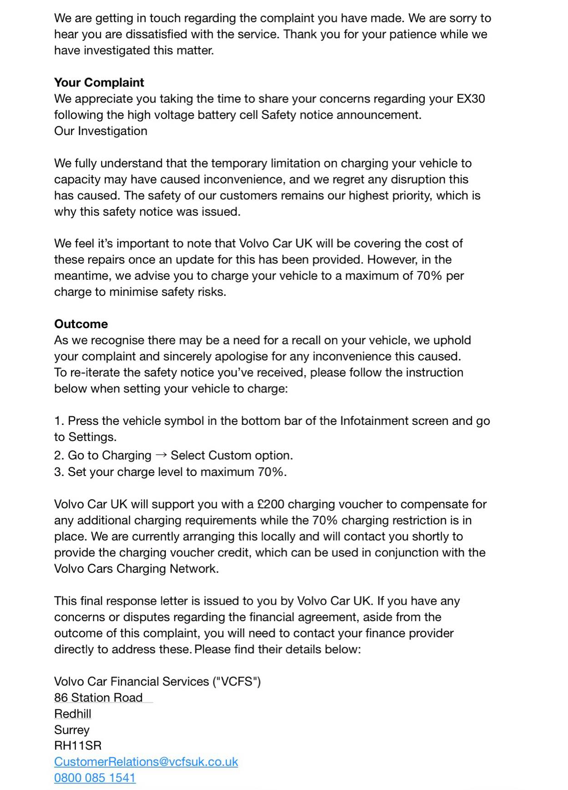
Volvo Car UK Final Response Letter
We are getting in touch regarding the complaint you have made. We are sorry to hear you are dissatisfied with the service. Thank you for your patience while we have investigated this matter.
Your Complaint We appreciate you taking the time to share your concerns regarding your EX30 following the high voltage battery cell Safety notice announcement.
Our Investigation We fully understand that the temporary limitation on charging your vehicle to capacity may have caused inconvenience, and we regret any disruption this has caused. The safety of our customers remains our highest priority, which is why this safety notice was issued.
We feel it’s important to note that Volvo Car UK will be covering the cost of these repairs once an update for this has been provided. However, in the meantime, we advise you to charge your vehicle to a maximum of 70% per charge to minimise safety risks.
Outcome As we recognise there may be a need for a recall on your vehicle, we uphold your complaint and sincerely apologise for any inconvenience this caused. To re-iterate the safety notice you’ve received, please follow the instruction below when setting your vehicle to charge:
- Press the vehicle symbol in the bottom bar of the Infotainment screen and go to Settings.
- Go to Charging → Select Custom option.
- Set your charge level to maximum 70%.
Volvo Car UK will support you with a £200 charging voucher to compensate for any additional charging requirements while the 70% charging restriction is in place. We are currently arranging this locally and will contact you shortly to provide the charging voucher credit, which can be used in conjunction with the Volvo Cars Charging Network.
This final response letter is issued to you by Volvo Car UK. If you have any concerns or disputes regarding the financial agreement, aside from the outcome of this complaint, you will need to contact your finance provider directly to address these. Please find their details below:
Volvo Car Financial Services (“VCFS”) 86 Station Road Redhill Surrey RH1 1SR [email protected] 0800 085 1541
This is our final response letter which means you have the right to refer your complaint to The Motor Ombudsman, free of charge – but you must do so within six months of the date on this letter/email.


Thank you for this update. I have seen a lot of discussion and advice for owners who have their car under PCP financing but what about owners who have bought using a simple loan with vcfs (I bought mine using their 50% down, balance over 36 months 0% interest). As others have done, I have sent a written complaint to Volvo UK (but not vcfs) but have not yet received an update.
Our EX30 was our first venture into EV and Volvo. It will probably be our last with Volvo. I made the unfortunate decision for all the right reasons to go EV but with the wrong manufacture. Whilst one US individual has done its best to get the world to ramp up fuel prices another has built the car I should have bought.
Volvo has been appalling in its communication and resolution and whilst I accept this is a big recall; other car companies have managed bigger recalls and faster.
Having spoken with Volvo UK today it is clear they have no idea of a timescale to resolve the issue, and their local dealer did not even know there was a resolution being prepared, when I (laughably) took my car for its first service.
Back to the ICE !
Seething of Berkshire
Here we are, 16th of April 2026, nearly a third of a year since this problem was notified to us. So far, I’ve received the same letter from Volvo 3 times, offering no new information since the first one arrived in December. We bought our car outright without finance and have become increasingly frustrated with what now feels like a stone-wall of silence. The lack of communication is terrible. I phoned the customer service number 6 weeks ago and was told a solution was near. Instead, I’ve received another duplicate letter. At this point, I doubt I’ll ever buy a Volvo, or any car made by their parent company again.
I live in Glasgow and have just submitted a complaint to Volvo financial services to reject the car. I as has everyone else with the battery recall have been limited to 70% charge which has had a massive impact at home. My husband and I both have EVs so have to share the home charger which has been a massive disruption. I also have a severe ADHD child so having to stop and get out the car if something was to happen is causing me anxiety as it would be very dangerous.
From what I am hearing the cars are now being booked in to get repaired by my garage in Glasgow still have no information about when the fix will be for myself. Now over 4 months in, I feel it exceeds the ‘reasonable’ time for the garage to fix the car.
I also think it is highly unlikely Volvo will accept my rejection but I really don’t want this car anymore and with being only 18 months into my PCP agreement there is no way out other than a rejection of the car.