
With the EX30 now facing confirmed battery‑related recalls in the United States, Canada, Australia, and Ireland, UK owners are increasingly wondering what this means for the car’s future value. It’s a fair question — especially when the defect involves the high‑voltage battery, the most expensive component in any electric vehicle.
The UK is in an awkward position. Volvo UK has already acknowledged the issue to owners, but there’s still no official recall listed on the GOV.UK database. That gap between what the manufacturer is saying privately and what the government has published publicly has created a strange limbo. And limbo is never good for resale confidence.
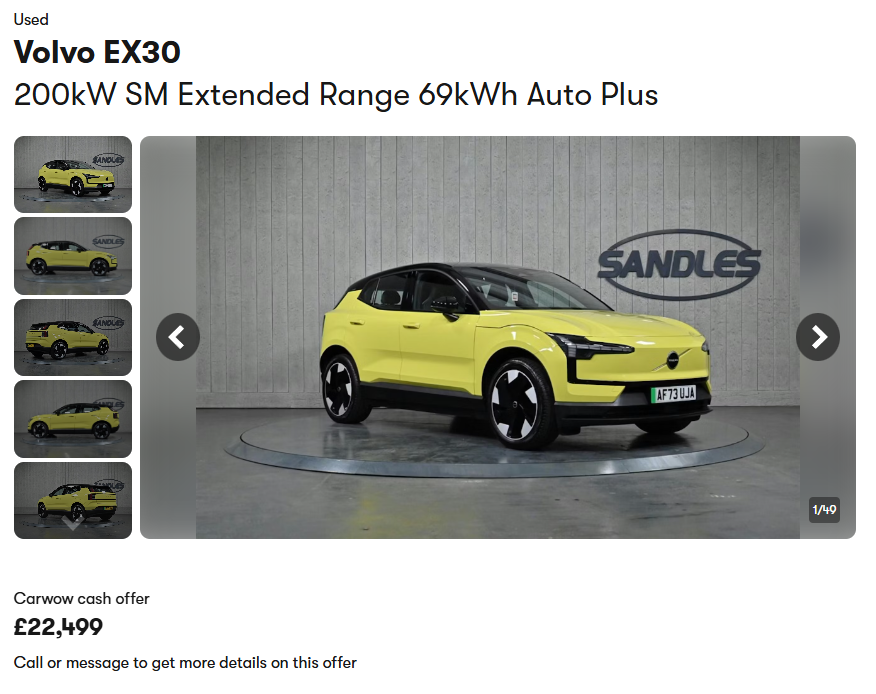
We’re already seeing signs of that uncertainty in the market. Posts in the EX30 UK Facebook owners’ group show significant dealer discounts on cars known to fall within the affected build dates. These aren’t token reductions — they’re the kind of price drops that suggest retailers are trying to move stock before the situation becomes more formalised. It’s not a collapse, but it’s a clear signal that the trade is bracing for turbulence.
This all lands at a time when EV depreciation in the UK is already unusually high. Used electric cars have been losing value faster than their petrol and diesel equivalents for the past two years, driven by a mix of falling new‑car prices, rapid model turnover, and lingering concerns about battery longevity. The EX30 recall adds another layer of doubt to a market that was already fragile.
There’s also the wider policy backdrop to consider. The UK government’s plan to introduce a pay‑per‑mile charge for EVs has taken some of the shine off electric‑car ownership. Even though the details aren’t final, the announcement alone has made some buyers more cautious. Combine that with a high‑profile battery recall and you get a used market that’s noticeably more hesitant than it was even a few months ago.
In the short term, it’s reasonable to expect softer demand for affected EX30s. Not a crash, but a cooling — especially while the UK remains the only major market without a formal recall notice. Buyers do their homework, and when they see other countries acting decisively while the UK stays quiet, it creates a sense that something is happening behind the scenes that hasn’t yet been acknowledged publicly.
Longer term, everything depends on the fix. If Volvo delivers a clear, permanent repair — ideally a proper battery module replacement rather than a software patch — the market tends to stabilise. We’ve seen this with the Hyundai Kona and Chevy Bolt: values dipped during the uncertainty, then recovered once owners had paperwork showing their cars had been repaired to a higher standard than when they left the factory.
Where things get messy is if the remedy ends up being slow, partial, or poorly communicated. Buyers don’t mind recalls; they mind uncertainty. A car with a completed recall and a clean bill of health is far easier to sell than one stuck in a “charge to 70% until further notice” holding pattern.
For now, the smartest thing UK owners can do is document everything — dealer conversations, emails, recall letters, screenshots of the charging‑limit guidance. When it comes time to sell or trade in, a clear paper trail showing the car was repaired under an official recall can actually protect value rather than harm it.
The EX30 remains a desirable car with strong demand, but the recall has introduced a layer of doubt that won’t fully lift until Volvo provides a definitive fix — and until the UK government formally acknowledges the issue. Until then, the market will stay cautious, watching closely for the next update.
Read More
BBC News – EV Pay per mile Tax
https://www.bbc.co.uk/news/articles/c8jw9l7gx92o